Bulb Compatibility
Dimmable vs non-dimmable A19 LEDs
Choose by the installed control: a wall dimmer needs a compatible dimmable LED; a plain on/off switch can use either type when every other specification matches.
What “dimmable” actually tells you
An ordinary A19 LED contains electronic driver circuitry between the household supply and the light-emitting diodes. A bulb labeled dimmable has circuitry intended to keep operating as a compatible dimmer modifies the power waveform. A non-dimmable bulb is designed for normal full-power switching and makes no promise that its driver will respond properly to a dimmer.
A dimmable bulb can normally operate at full output on a standard on/off switch, provided its base, voltage, fixture requirements, and other ratings match. The reverse substitution is not equivalent: manufacturers direct users to choose a dimmable LED whenever a conventional dimmer controls the circuit.
The dimmability statement is also separate from the federal Lighting Facts panel. That panel reports items such as lumens, energy use, estimated cost, life, and light appearance. Look elsewhere on the package or specification sheet for “dimmable,” “non-dimmable,” and any dimmer instructions.
What the label does not guarantee
“Dimmable” does not mean compatible with every dimmer or capable of fading smoothly to darkness. LED bulbs and controls are model-specific electronic loads. Even two products that both say LED-compatible can produce different low-end results when paired.
A mismatched combination may flicker, buzz, turn on late, drop out before reaching the dimmer’s lowest setting, or offer only a narrow adjustment range. These symptoms commonly indicate a compatibility, loading, or trim-setting issue; they do not by themselves prove that the bulb or household wiring is defective.
- It does not promise a stated minimum brightness unless the manufacturer provides one.
- It does not identify whether the control uses forward-phase, reverse-phase, or another dimming method.
- It does not override the dimmer’s permitted lamp type, LED wattage limit, minimum load, or bulb-count guidance.
- It does not mean a smart bulb should be placed on a wall dimmer. Many smart bulbs dim internally through an app and require steady full power.
Keep the other identifiers separate
A replacement succeeds only when several independent specifications line up. Manufacturer catalogs list these fields separately because none can safely stand in for another. In particular, “A19,” “E26,” and “120 V” answer three different questions.
The fixture label and its model documentation take priority. If the fixture specifies a lamp type, maximum wattage, location rating, or other restriction, follow that wording rather than assuming that an efficient LED is automatically acceptable.
- Shape: A19 describes the familiar general-purpose bulb form. It does not name the screw base.
- Base: E26 identifies a medium screw base. Many U.S. A19 bulbs use it, but verify the marking instead of treating it as part of the A19 code.
- Voltage: A 120-volt marking describes the intended supply. Base fit alone does not establish voltage compatibility.
- Fixture rating: Compare actual input watts with the fixture limit. A “60-watt replacement” describes light output, not 60 watts of electricity use.
- Dimmer compatibility: Match the exact bulb and dimmer models when a tested compatibility list is available. Include every bulb controlled by that dimmer when checking its load rules.
- Enclosure rating: Verify explicit permission for fully enclosed fixtures. Dimmability and enclosure suitability are independent ratings.
Choose according to the control already installed
With a plain on/off switch, either an otherwise suitable dimmable bulb or a suitable non-dimmable bulb can provide full-output operation. Dimmability adds an unused control capability; it does not make the bulb brighter or change the socket.
With a wall or lamp dimmer, use an ordinary LED explicitly labeled dimmable and check the control manufacturer’s compatibility guidance. Do not treat leaving the slider at maximum as permission to install a non-dimmable bulb, because the control remains a dimmer and may not deliver the same waveform as a mechanical switch.
Special products need their own instructions. Three-way bulbs, bulbs that step through levels when power is toggled, and app-controlled smart bulbs use different control schemes. Their ability to change brightness does not automatically establish compatibility with a conventional wall dimmer.
How to evaluate a dimmable pairing
Start with the bulb manufacturer’s dimmer guide or the dimmer maker’s tested-bulb tool. Match model numbers, not merely brand names. Also check the dimmer’s LED load rating and any limit on the number of lamps; LED and incandescent ratings on the same control may differ.
After installation, test the full range while the bulbs are cold and again after normal operation. Confirm that every lamp starts consistently, remains stable at the desired low setting, switches fully off, and does not produce objectionable noise. Some LED dimmers provide low-end or high-end trim adjustments, but use the control’s instructions rather than guessing at settings.
If performance remains poor, try a documented compatible pairing or contact the manufacturers. Persistent flicker on a normal on/off circuit, visible damage, unusual heat, or a burning odor is not ordinary dimmer tuning; switch the light off and investigate the fixture, connection, and lamp according to their documentation.
- Use the same bulb model across a multi-bulb dimmed fixture when practical.
- Do not mix dimmable and non-dimmable bulbs on one dimmed circuit.
- Check whether the dimmer requires a minimum load or a neutral connection.
- Treat compatibility-list results as model-specific, since revisions and unlisted combinations may behave differently.
What the manufacturer examples show
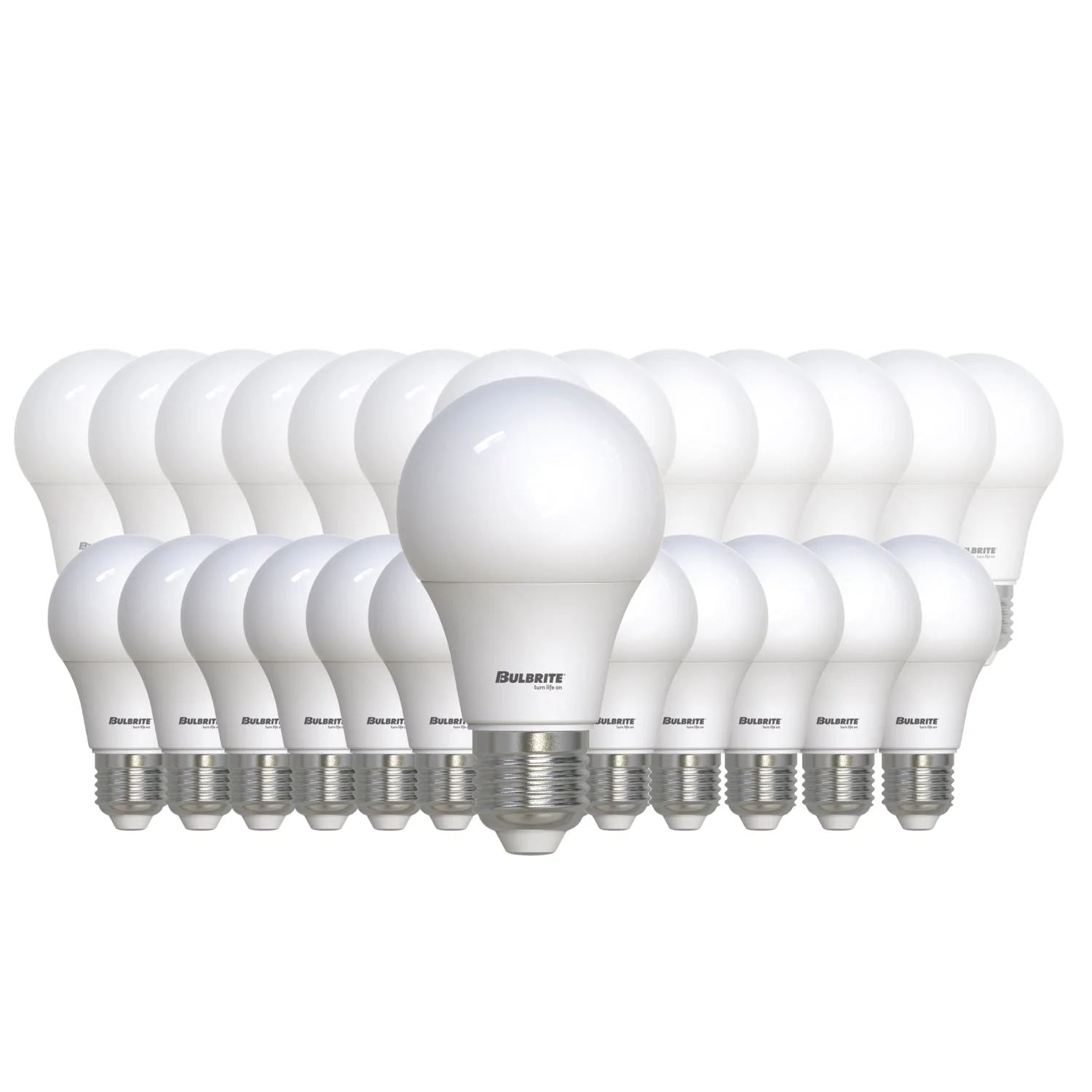
The limited catalog snapshot illustrates why dimmability must remain its own field. Bulbrite lists 120-volt, E26, 3000 K A19 models in both categories, but its sampled dimmable and non-dimmable products also differ in lumens, actual watts, CRI, and rated life. Those differences belong to the individual models and should not be attributed to dimmability alone.
Philips likewise catalogs dimmable and non-dimmable 120-volt E26 A19 families across several output levels. Feit, SYLVANIA, and Westinghouse listings separately state shape, base, light output, power, color temperature, and dimmability. Westinghouse examples also show that both a dimmable A19 and a non-dimmable A19 can be approved for totally enclosed fixtures, confirming that enclosure suitability is an independent rating.
Use these examples as label-reading demonstrations, not as a census of available bulbs. Catalogs change, omitted properties remain unknown, and the exact package, specification sheet, dimmer documentation, and fixture label control the final choice.
Before you buy
A quick replacement check
- Confirm that the bulb is marked A19 if that is the required shape.
- Match the base code, commonly E26 in U.S. household fixtures.
- Verify the bulb’s rated voltage against the supply and fixture documentation.
- Use a dimmable bulb whenever a conventional dimmer controls the circuit.
- Check the exact bulb and dimmer models against available compatibility guidance.
- Compare actual input watts, not replacement-equivalent watts, with the fixture limit.
- Verify enclosure, damp or wet-location ratings, overall dimensions, and physical clearance separately.
Common follow-ups
Questions people ask next
Which is better, a dimmable or non-dimmable A19 LED?
Neither is universally better. A dimmable model is required for a conventional dimmer and also works on an ordinary switch when otherwise compatible. A non-dimmable model is appropriate only for full-power on/off operation.
Can I use a dimmable A19 LED on a regular on/off switch?
Yes, an ordinary line-voltage dimmable bulb can generally run at full output on a standard switch when its base, voltage, wattage, enclosure rating, and other fixture requirements match. Smart and specialty bulbs may have different instructions.
Can I use a non-dimmable LED if I leave the dimmer at full brightness?
Do not rely on that workaround. Manufacturers recommend a bulb labeled dimmable on a dimmer-controlled circuit because even the highest setting may not behave like an ordinary mechanical switch.
Does “60-watt replacement” count as 60 watts against the fixture limit?
No. The replacement figure is an incandescent-output comparison; the bulb’s actual input wattage is the electrical consumption. Still obey any fixture restriction on lamp technology or type, not just its wattage ceiling.
Why does a bulb flicker even though both the bulb and dimmer say LED-compatible?
General LED compatibility is not the same as a tested model pairing. Minimum load, bulb count, dimming method, trim settings, or the bulb’s driver can affect performance, so consult both manufacturers’ model-specific guidance.
Checked against
Sources
- Public guidanceU.S. Department of Energy — Purchasing Energy-Efficient Light Bulbs ↗Accessed 2026-08-26
- Public guidanceFederal Trade Commission — Shopping for Light Bulbs ↗Accessed 2026-08-26
- Manufacturer documentLutron Electronics — Challenges of Dimming LED Loads ↗Accessed 2026-08-26
- Manufacturer documentBulbrite — 8.5W LED A19 60W Equivalent Basics Non-Dimmable 3000K E26 120V ↗Accessed 2026-08-26
- Manufacturer documentFeit Electric — LED Dimmer Compatibility Guide ↗Accessed 2026-08-26
- Manufacturer documentSignify — Philips A19 LED Lamp Bulletin PLt-2407BN ↗Accessed 2026-08-26
- Manufacturer documentLEDVANCE — SYLVANIA TruWave A19 100W-Replacement Dimmable Bright White LED ↗Accessed 2026-08-26
- Manufacturer documentWestinghouse Lighting — Westinghouse A19 6.5-Watt Dimmable Filament LED ↗Accessed 2026-08-26