
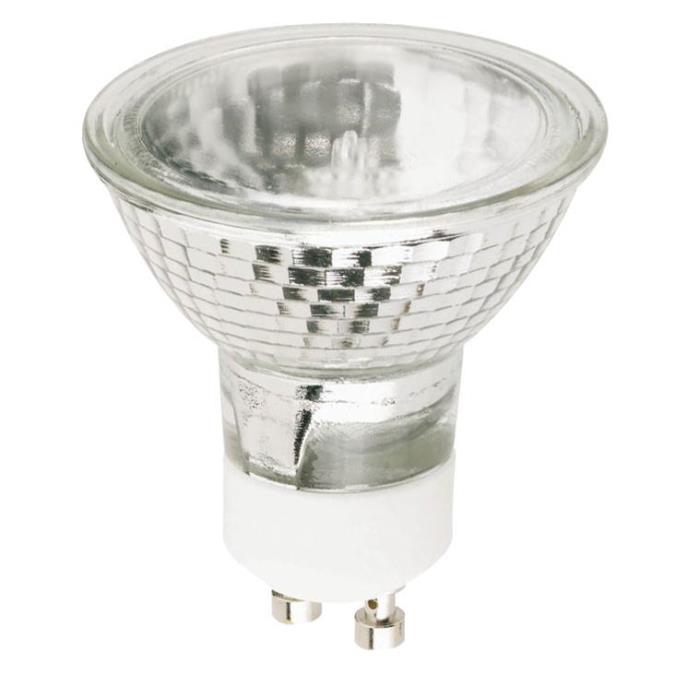

How to identify GU10
- Look for two stout pins with mushroom-shaped ends.
- Measure from the center of one pin to the center of the other.
- A GU10 locks with a short push-and-turn motion.
Where it is commonly used
Common use is a clue, not proof. The fixture label and model documentation take priority over a visual match.
Bulb shapes sold with this base
You may see these shapes with a GU10 base. The base code does not guarantee the bulb width, length, beam angle, or clearance.
Before you buy a replacement
- Do not confuse GU10 with straight-pin GU5.3 lamps.
- Check beam angle and bulb length before replacing a spotlight.
- Range-hood installations may have specific heat requirements.
Quick answers
Questions about the GU10 bulb base
What is a GU10 bulb base?
A GU10 bulb has two short pins with widened ends spaced a nominal 10 mm apart. It pushes in and twists to lock, but GU10 does not define one overall diameter, length, voltage, or beam angle.
What size is a GU10 bulb base?
GU10 has a nominal 10 mm pin spacing. Pin spacing is measured from the center of one pin to the center of the other. Use the printed base code when available because a visual estimate is not conclusive.
Where is a GU10 bulb base commonly used?
Common examples include track lighting, spotlights, range hoods, recessed accent lights. Fixture type is only a clue; confirm the code on the bulb, socket, fixture label, or manufacturer documentation.
Can I choose a GU10 replacement by appearance alone?
No. Match the GU10 connection first, then verify voltage, actual input wattage, bulb dimensions, fixture restrictions, controls, and any enclosure or location rating required by the installation.
Are all GU10 bulbs the same size and voltage?
No. GU10 identifies the twist-lock connection, not the lamp's overall dimensions or voltage. Match the printed voltage and check length, diameter, beam angle, and fixture clearance on the exact model.
What is the standard size of a GU10 bulb?
GU10 specifies nominal 10 mm pin spacing, not one standard overall bulb size. PAR16 and MR16-style GU10 lamps are commonly about 50 mm in diameter, but length and exact diameter vary by model.