Bulb base guide
GU10 replacement: voltage, size, beam angle
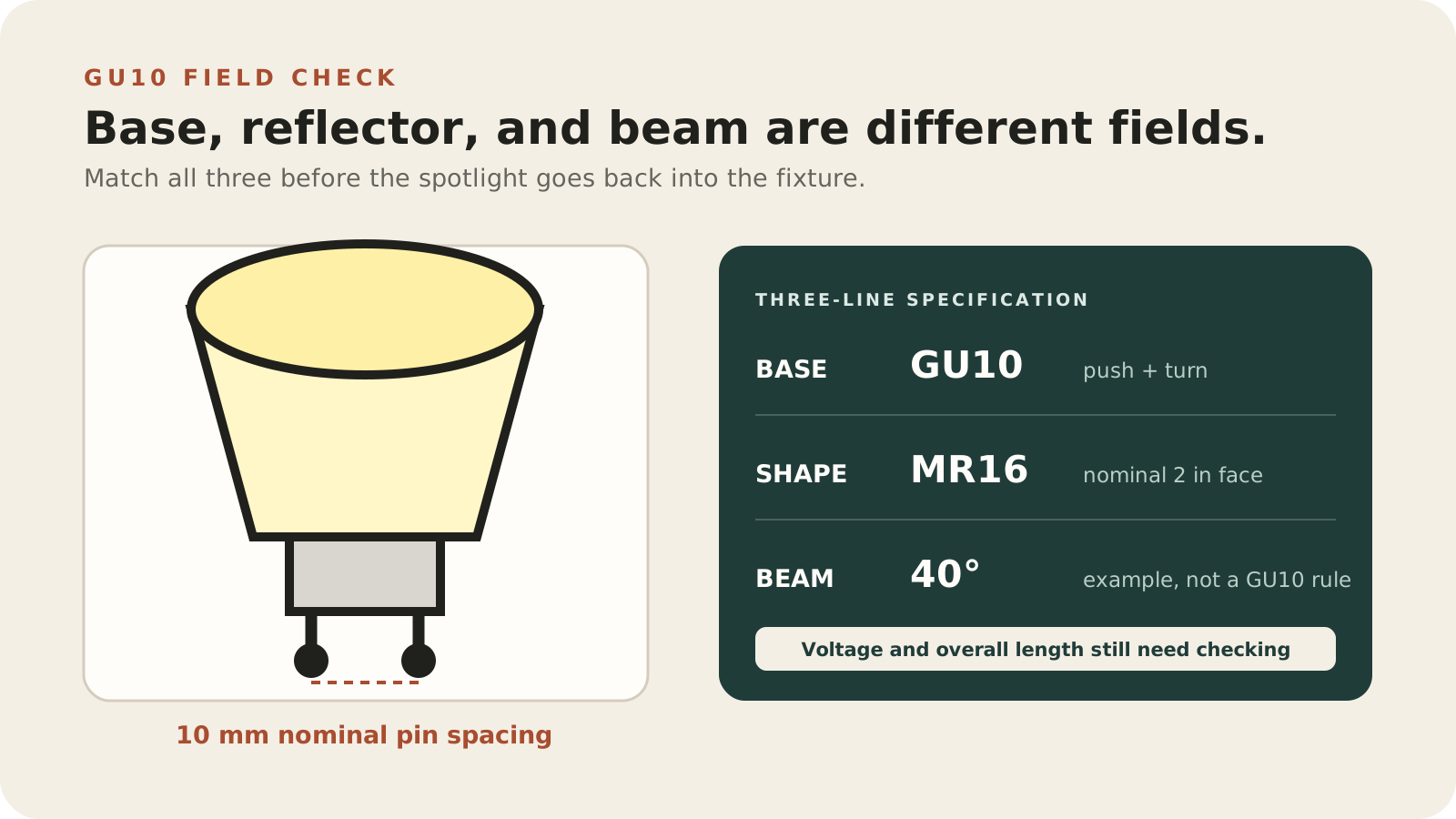
GU10 identifies the push-and-turn connection beneath many compact spotlights. The same code does not determine voltage, reflector diameter, beam angle, brightness, or overall length.
Reference table
GU10 and GU5.3 are not the same connection
Both bases are commonly attached to compact MR16 reflectors, which is why the lamp's front shape alone is not enough for identification.
| Check | GU10 | GU5.3 |
|---|---|---|
| Pins | Short pins with widened locking ends | Two thin straight pins |
| Nominal spacing | 10 mm center to center | 5.3 mm center to center |
| Installation | Push and rotate to lock | Push straight into socket |
| Voltage | Often line voltage; verify exact lamp | Often low voltage; verify exact lamp |
| Common shape | MR16 or PAR16 | MR16 |
| Interchangeable? | No | No |
Codes identify one part of the lamp. The fixture label and exact model specifications still control.
How to identify a GU10 base
Switch off power and let the lamp cool. A GU10 base has two short, sturdy pins ending in widened heads. The bulb enters the socket and rotates a short distance to lock. The nominal spacing is 10 mm from the center of one pin to the center of the other.
Do not identify it from the reflector face alone. GU10 and GU5.3 bases are both commonly attached to MR16-shaped lamps. GU5.3 has two thin straight pins and pushes straight in; GU10 uses widened locking pins and turns. A PAR16 lamp can also use GU10, so the shape code and base code remain separate.
If the lamp is recessed behind a trim or mounted in a range hood, photograph the base and full marking as it comes out. Do not twist an unknown straight-pin lamp or pull hard on a locked GU10. Follow the fixture's release method when a retaining ring or suction tool is involved.
GU10 does not guarantee voltage
GU10 is often associated with line-voltage spotlights in U.S. homes, and many current Feit Electric MR16 GU10 LEDs are marked 120 V. That is a common product pattern, not a rule encoded in the base. The official catalog also contains a GU10 model with another stated voltage, illustrating why the exact marking must control.
Match the replacement voltage to the old lamp and fixture documentation. Do not infer it from the words GU10, MR16, LED, track light, or range hood. A physically matching lamp can still be wrong for the supply, transformer, or control system.
Use actual input watts for the fixture's wattage limit. A lamp advertised as a 50-watt replacement may consume only a fraction of that power, but the fixture's lamp-type, enclosure, orientation, or model-specific restrictions remain in force.
MR16 describes shape and size, not the socket
MR16 is a multifaceted-reflector shape designation with a nominal diameter class of 16 eighths of an inch, or 2 inches. That description applies to the reflector envelope. It does not tell you whether the connection is GU10 or GU5.3, and it does not specify voltage or beam angle.
PAR16 is another compact reflector designation found with GU10 bases. Even when two lamps share a nominal front diameter and GU10 connection, their necks, housings, and maximum overall lengths can differ. Check the fixture opening, trim, socket depth, and clearance behind the face.
Official product records show the separation clearly: Feit lists an MR16 GU10 LED at 120 V with a 40-degree beam and also publishes other GU10 reflector models with different wattage, output, or dimensions. Read the full line of specifications rather than treating MR16 GU10 as one fixed lamp.
Beam angle changes where the light goes
Beam angle describes the spread of directional light. A narrower beam concentrates light on a smaller area, while a wider flood distributes it more broadly. GU10 does not determine beam angle, and two bulbs with the same base, lumens, and color temperature can produce noticeably different lighting on artwork, counters, floors, or walls.
Match the old beam angle when preserving an existing lighting effect. If the old value is unknown, consider the distance to the target and the size of the area that should be illuminated. A range hood generally needs useful coverage of the cooking surface, while an accent spotlight may intentionally use a tighter beam.
Lumens measure total light output, not beam width. Compare both specifications. Also check color temperature and color rendering if the lamp illuminates finishes, food, artwork, or merchandise where appearance matters.
Check dimming, heat, and location ratings
For a dimmed fixture, the exact GU10 lamp must be labeled dimmable and compatible with the installed control. Driver and dimmer combinations can differ in minimum level, start-up, flicker, ghosting, and audible noise. Use a manufacturer compatibility list when one is available.
Recessed cans, small track heads, and range hoods may retain heat. Use a lamp with explicit approval for the enclosure or operating condition stated by the fixture manufacturer. The Department of Energy warns that trapped heat can affect some LED lamps, so a lower actual wattage does not make every LED suitable for every covered fixture.
Moisture and temperature requirements are separate. A range hood may impose appliance-specific heat, grease, size, or shield requirements. An outdoor spotlight needs the appropriate dry, damp, or wet-location rating. GU10 alone answers none of those questions.
Seating the replacement in a GU10 socket
Start with the full old-lamp code and fixture label. Record the base, voltage, shape, maximum diameter, overall length, actual watts, lumens, beam angle, color temperature, dimming status, and any enclosure or location rating. Search the exact model where possible.
When installing, align the widened pins with the socket openings, push gently, and rotate only as directed. If it will not lock without force, stop and recheck the base and socket condition. Restore trim, shields, and retaining rings exactly as the fixture manufacturer specifies.
- Confirm widened GU10 pins and nominal 10 mm spacing.
- Match the printed voltage rather than assuming line voltage.
- Check MR16 or PAR16 diameter and exact overall length.
- Match lumens, beam angle, color temperature, and color rendering.
- Verify dimmer, enclosure, range-hood, and location requirements.
Before you buy
A quick replacement check
- Switch off power, let the lamp cool, and record its complete marking.
- Confirm a GU10 push-and-turn base rather than straight-pin GU5.3.
- Match the exact voltage and actual input-wattage requirements.
- Measure reflector diameter, overall length, trim opening, and socket depth.
- Choose both lumens and beam angle for the intended lighting effect.
- Verify dimmer compatibility and any sensor or smart-control requirements.
- Match enclosure, appliance, and dry/damp/wet-location ratings.
Common follow-ups
Questions people ask next
Is every GU10 bulb 120 volts?
No. Many U.S. GU10 products are 120 V, but GU10 identifies the base, not voltage. The exact lamp and fixture marking must establish the supply rating.
Are GU10 and MR16 the same thing?
No. GU10 is a base; MR16 is a reflector shape and nominal diameter class. An MR16 lamp may use GU10, GU5.3, or another specified connection.
Can GU10 replace GU5.3?
No. GU10 has widened twist-lock pins at nominal 10 mm spacing; GU5.3 has straight pins at nominal 5.3 mm spacing. Their common voltage patterns also differ.
What beam angle should a GU10 bulb have?
Match the old lamp or the intended task. Narrower beams concentrate light; wider beams cover more area. GU10 does not prescribe a beam angle.
Can I use a GU10 LED in a range hood?
Only when the hood documentation permits that base and lamp type and the exact LED meets its voltage, dimensions, heat, enclosure, control, and shield requirements.
Checked against
Sources
- Standard / definitionNational Electrical Manufacturers Association — ANSI C81.61—Electric Lamp Bases, Contents and Scope ↗Accessed 2026-08-21
- Manufacturer documentFeit Electric — 35W Replacement MR16 GU10 Reflector LED ↗Accessed 2026-08-21
- Manufacturer documentFeit Electric — 20W Warm White GU10 Base 120V Xenon Light Bulb ↗Accessed 2026-08-21
- Manufacturer documentLEDVANCE — Guide to Light Bulb Shapes, Types, and Sizes ↗Accessed 2026-08-21
- Public guidanceU.S. Department of Energy — Purchasing Energy-Efficient Light Bulbs ↗Accessed 2026-08-21
- Manufacturer documentLutron Electronics — LED Compatibility Tool ↗Accessed 2026-08-21