Bulb Shapes and Codes
What does ST19 mean? Bulb shape, size, and base
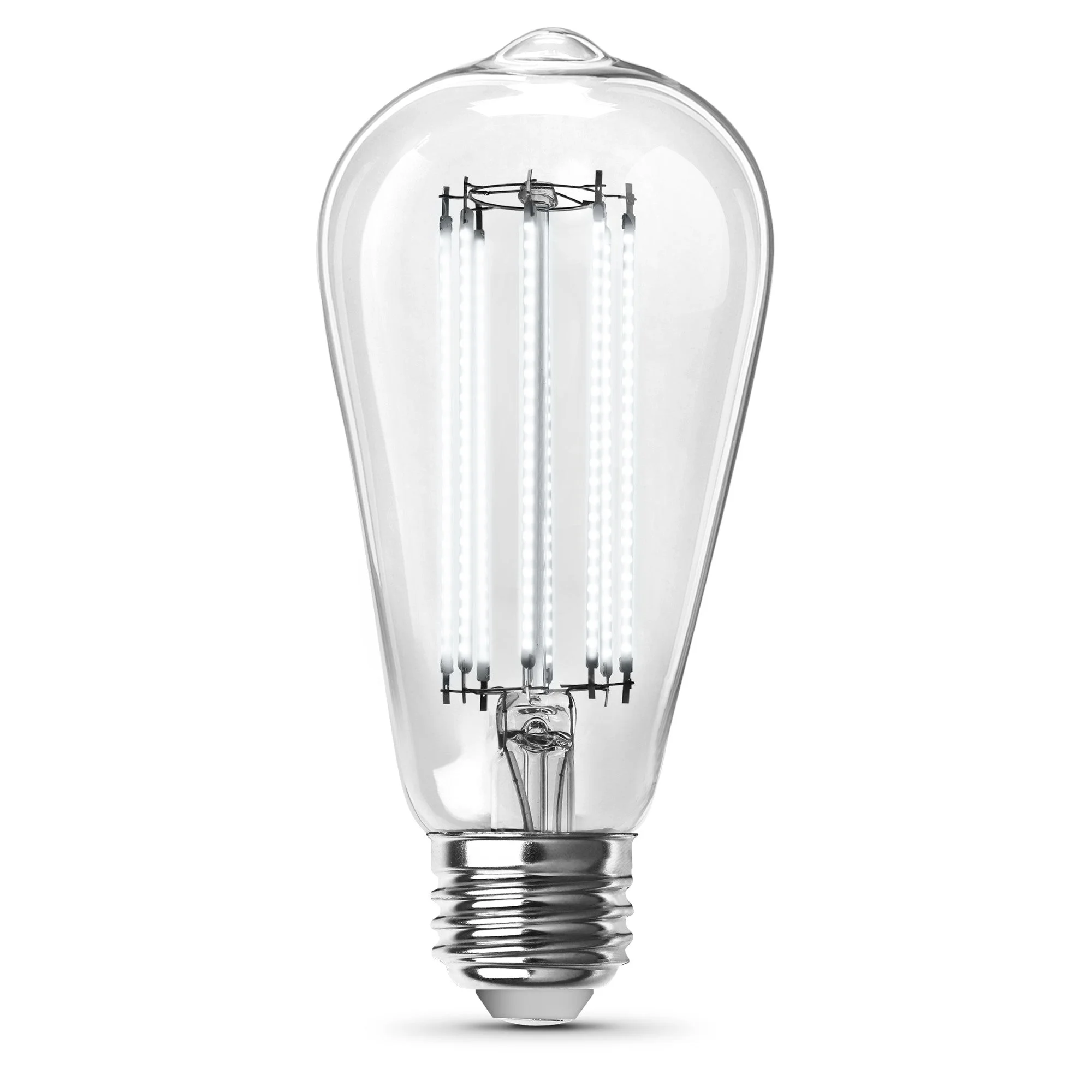
ST19 describes an Edison-style bulb shape with a nominal 2 3/8-inch diameter (about 60 mm). Check the exact model for length, width, base, and voltage.
Reference table
ST19 size: nominal code vs an actual bulb
The dimensions encoded in a shape name are not a fit guarantee. The model example below is Feit Electric ST19100CL/950CA/2; its ratings do not apply to every ST19. On a phone, swipe the table sideways to see the model column.
| Check | ST19 code alone | Feit ST19100CL/950CA/2 |
|---|---|---|
| Shape | Straight-tubular envelope | ST19 |
| Diameter / width | Nominal 2 3/8 in (about 60 mm) | Published width: 2.5 in |
| Overall length | Not specified by the code | Published length: 5.4 in |
| Base | Check the separate base code | E26 |
| Voltage | Check the electrical rating | 120 V |
| Input and brightness | Check watts and lumens separately | 15 W; 1,490 lumens |
| Enclosure / location | Check both ratings on the exact model | Enclosed-fixture rated; damp location |
Codes identify one part of the lamp. The fixture label and exact model specifications still control.
What the ST19 code actually describes
ST19 describes the bulb envelope—the outer shape usually associated with an elongated, vintage Edison-style bulb. “ST” means straight tubular. In practice, the outline is taller than a familiar pear-shaped household bulb, with relatively straight sides and a taper toward the base. The code does not describe the filament pattern, glass color, light source, or socket.
The number belongs to the traditional U.S. eighth-inch sizing system. Nineteen eighths equals 2 3/8 inches, so ST19 identifies a nominal diameter class of about 2.375 inches. Treat that as a naming convention rather than a guaranteed measured dimension. The applicable NEMA nomenclature standard defines envelope shapes independently of lamp bases, and manufacturers may publish dimensions that differ slightly from the nominal code.
For example, Feit Electric’s ST19100CL/950CA/2 is labeled ST19 but has a stated width of 2.5 inches and length of 5.4 inches. Its page separately identifies an E26 base, 120-volt operation, LED filament technology, and other performance details. That separation is the key to reading any ST19 listing correctly.
Base code and voltage are separate checks
ST19 does not mean E26. ST19 identifies the envelope, while E26 identifies a medium screw base. A listing that says “ST19 E26” is supplying two different pieces of information: the shape and size family of the glass, followed by the socket interface. Match the base code printed on the old bulb, fixture label, or fixture documentation rather than assuming it from the silhouette.
Voltage is another independent specification. A bulb with the correct E26 threads can still have the wrong electrical rating. For an ordinary U.S. line-voltage fixture, compare the lamp’s marked voltage or voltage range with the fixture and supply. Do not infer voltage from ST19, E26, the bulb’s appearance, or the word “Edison.”
Also check whether the fixture requires a particular lamp technology or type. The fixture label and model instructions take priority when they are more specific than the bulb package.
- ST19 describes the envelope.
- E26 describes a medium screw base.
- The voltage marking describes the intended electrical supply.
Use actual watts for the fixture limit and lumens for brightness
A package may show both actual wattage and an incandescent-replacement figure. They serve different purposes. Actual wattage—often labeled “Energy Used”—is the bulb’s electrical input. “60W replacement” or “100W equivalent” is a brightness comparison, not the power the LED draws.
When checking a fixture’s maximum-wattage label, use the bulb’s actual input wattage and obey any stated lamp-type restriction. Read the complete fixture label: a low-watt LED is not automatically approved for every fixture, because enclosure limits and other instructions remain separate.
For brightness, compare lumens rather than watts or the ST19 code. The Federal Trade Commission explains that lumens measure light output, while watts measure energy use. Its Lighting Facts guidance also points readers to light appearance, expected life, and energy use. In the Feit example, the distinct specifications are 15 actual watts, a 100-watt replacement claim, and 1,490 lumens.
“Dimmable” does not settle dimmer compatibility
If the fixture is switched only on and off, a dimmable bulb can generally be used without invoking its dimming function. On a dimmed circuit, first confirm that the bulb itself is marked dimmable. Then check the dimmer manufacturer’s compatibility information for the exact dimmer and lamp model or seek the lamp maker’s recommended dimmers.
LED drivers do not all respond identically to every dimmer. Lutron notes that compatibility affects dimming performance and maintains model-specific test information. A generic “dimmable” marking therefore does not promise a particular dimming range or freedom from flicker, dropout, ghosting, or audible noise with every control. Smart bulbs and sensor-equipped bulbs may also have control requirements, so follow their own instructions.
Enclosure rating and location rating answer different questions
An enclosure rating concerns heat. Fully enclosed fixtures trap heat, which the Department of Energy says can affect the performance and life of some LED lamps. Use an ST19 in a sealed globe or other enclosed fixture only when the exact bulb is approved for that application and the fixture documentation permits it.
A dry, damp, or wet location rating concerns moisture exposure instead. UL guidance distinguishes dry-only luminaires from equipment suitable for damp or wet locations. Damp-rated equipment may be used in damp or dry locations; wet-rated equipment may be used in wet, damp, or dry locations. A covered porch may still require a specific rating based on its actual exposure and the fixture instructions.
Neither rating substitutes for the other. A damp-rated bulb is not thereby enclosed-fixture rated, and an enclosed-fixture-rated bulb is not thereby suitable for rain. Feit’s example lists “Damp” and “Enclosed Fixture Rated: Yes” as two separate specifications, illustrating why both fields must be checked.
Measure the fixture instead of relying on ST19 alone
Physical clearance is the last independent check. Compare the manufacturer’s maximum overall length and maximum diameter with the available space. Check the shade or globe opening, distance from the socket to the cover, width near the bulb’s shoulder, and clearance around any harp, cage, retaining ring, or decorative sleeve.
The nominal 2 3/8-inch diameter suggested by “19” does not tell you the total length, the shape near the base, or the exact production dimensions. DOE guidance notes that LED replacement lamps can be larger near the base because of their integrated electronics, so a matching screw base does not guarantee that the bulb will seat fully or clear a small fixture.
With the power off and the old bulb cool, record its full markings and measure its length and widest point. Then compare those details with the candidate bulb’s specification sheet. If the fixture label or model documentation imposes a narrower shape, lower wattage, different rating, or other restriction, follow that information even when the candidate is labeled ST19.
Before you buy
A quick replacement check
- Match the complete base code, such as E26.
- Match the bulb’s voltage to the fixture and supply.
- Stay within the fixture’s actual-watt and lamp-type limits.
- Choose brightness by lumens, not the ST19 code.
- Verify the exact bulb and dimmer combination.
- Check enclosed-fixture approval separately.
- Match both lamp and fixture location ratings.
- Compare published length and width with the available clearance.
Common follow-ups
Questions people ask next
What size is an ST19 light bulb?
The code indicates a nominal diameter of 19 eighths of an inch, or about 2 3/8 inches. It does not specify overall length, and an exact model can differ slightly from the nominal diameter, so use the manufacturer's dimensions for clearance.
Are ST19 and E26 the same specification?
No. ST19 describes the bulb envelope’s shape and nominal diameter class. E26 describes a medium screw base. A compatible replacement may need both designations, but neither one implies the other.
Will every ST19 bulb have exactly the same dimensions?
No. The code identifies a nominal shape and size family. Check the manufacturer’s stated maximum length and diameter because actual dimensions and the shape near the base can differ.
Which wattage should be compared with the fixture label?
Use the bulb’s actual input wattage, not its incandescent-equivalent claim, and follow any lamp-type restriction on the fixture. Use lumens when comparing brightness.
Is a damp-rated ST19 suitable for an outdoor fixture?
Only where the bulb’s rating, the fixture’s rating, and the model instructions cover the actual exposure. Damp and wet ratings are not interchangeable, and neither establishes enclosed-fixture approval.
Does a dimmable ST19 work with any dimmer?
No. The bulb must be dimmable, and the specific LED bulb and dimmer should also be compatible. Consult the dimmer’s tested-bulb information or the lamp manufacturer’s recommendations.
Checked against
Sources
- Standard / definitionNational Electrical Manufacturers Association — American National Standard for Electric Lamps—Nomenclature for Envelope Shapes Intended for Use with Electric Lamps ↗Accessed 2026-08-26
- Manufacturer documentFeit Electric — 15W ST19 E26 Dimmable Straight Filament Clear Glass Vintage Edison LED Light Bulb, Daylight ↗Accessed 2026-09-07
- Public guidanceU.S. Department of Energy — Purchasing Energy-Efficient Light Bulbs ↗Accessed 2026-09-07
- Public guidanceFederal Trade Commission — Shopping for Light Bulbs ↗Accessed 2026-09-07
- Manufacturer documentUL Solutions — Guide Information for Luminaires and Fittings ↗Accessed 2026-08-26
- Manufacturer documentLutron Electronics — Ghosting and Compatibility with LED Lights Using Maestro Dimmers ↗Accessed 2026-08-26