Bulb identification
How to read the letters and numbers on a light bulb
A field-by-field guide to reading household bulb markings without confusing physical fit, electrical ratings, and operating restrictions.
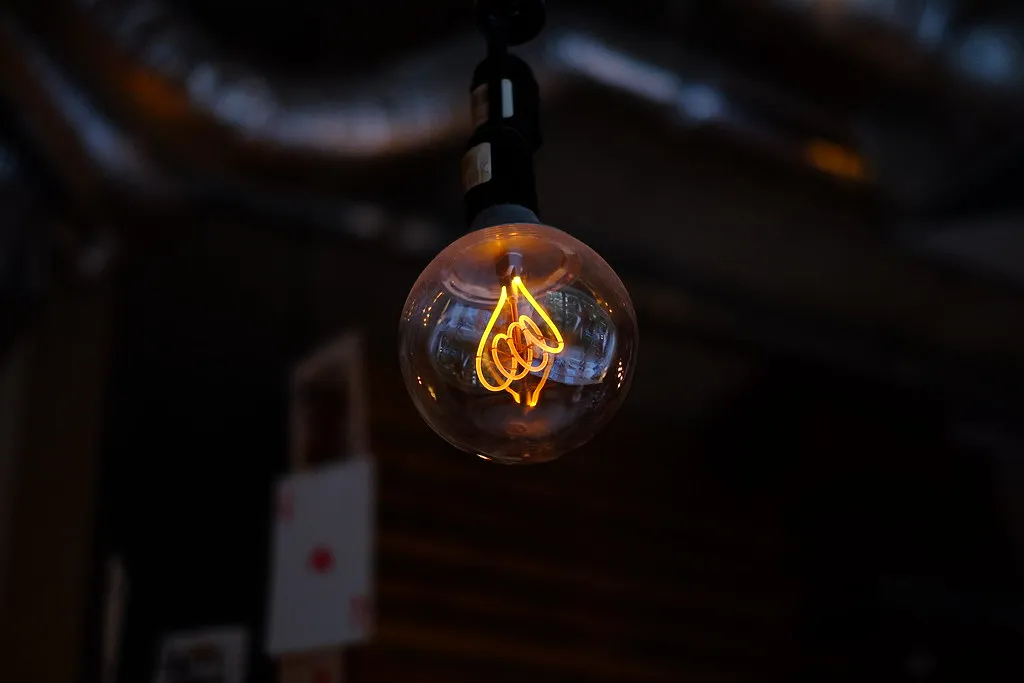
Treat the printing as several separate fields
Read each group of characters as a separate field. In a string such as “9A19/LED/927/FR/P/E26/DIM,” 9 may be the actual wattage, A19 the bulb envelope, 927 a compact color code, FR the finish, P the material, E26 the base, and DIM the dimming designation. That example follows a Philips-style product-number system; another manufacturer may arrange or abbreviate the same facts differently.
Printing also varies by product. Under the FTC Energy Labeling Rule, covered general-service lamps must carry their initial lumen output on the bulb itself, while most of the familiar Lighting Facts information appears on the package. If an unexplained number remains, treat it as a model or ordering identifier and search it with the brand name rather than trying to derive an electrical rating from it.
Bulb shape and size: A19, BR30, PAR38, G25, and T8
In common North American bulb designations, the letters identify the envelope family and the following number gives its approximate major diameter in eighths of an inch. An A19 is an A-line bulb approximately 19/8 inch, or 2⅜ inches, across. A BR30 reflector is approximately 30/8 inch, or 3¾ inches, across. G-series bulbs are globes, T-series bulbs are tubular, and R, BR, MR, and PAR families are directional reflector shapes.
That number describes the bulb envelope—not its screw base, overall length, neck width, or required socket. It also does not guarantee clearance inside a shade or recessed trim. LED replacements can be bulkier near the base because they contain a driver, and two bulbs carrying the same nominal shape code can have different overall dimensions. Compare maximum width and overall length with the old bulb or the manufacturer’s dimensional drawing, especially in clips, narrow shades, recessed cans, and fixtures with covers.
Base code: E26, E12, GU10, and GU5.3
The base code describes the mechanical and electrical connection. E26 is the familiar medium Edison screw base; the number indicates a nominal 26-millimeter diameter. E12 is the smaller candelabra screw base. Manufacturers classify GU10 and GU24 as twist-and-lock bases, while codes such as G4 and GU5.3 identify pin-base families.
Keep this separate from bulb shape. A19 does not mean E26: A19 lamps are also manufactured with other bases, including GU24. Likewise, an E26 base can support several bulb shapes. Match the complete base designation, not merely the number or a similar-looking pair of pins. GU10 and GU5.3, for example, differ in both construction and typical electrical application even though both commonly appear on small reflector lamps.
Electrical ratings: volts, hertz, and watts
“120V 60Hz” identifies the intended electrical input: 120 volts alternating current at 60 hertz, typical of U.S. household lighting circuits. A range such as “120–277V” is usable across that stated range only when the manufacturer explicitly specifies it. Do not infer voltage from the bulb’s shape or base. A 12V MR16/GU5.3 lamp belongs on a compatible low-voltage system and may involve an electronic or magnetic transformer; it is not interchangeable with a 120V lamp merely because it fits a similar fixture opening.
“9W” is the bulb’s actual input power. “60W replacement,” “60W equivalent,” or similar wording is a brightness comparison with a traditional lamp, not the LED’s electrical consumption. Lumens, not equivalent watts, are the direct measure used to compare light output.
A fixture label such as “MAX 40W” is a fixture rating. Compare it with the replacement bulb’s actual wattage, not its advertised equivalent wattage. A 9W LED labeled “60W replacement” draws 9 watts. Even so, follow any additional limits on the fixture label—such as an LED-specific maximum, required bulb type, or enclosure restriction—and give the fixture’s model documentation priority.
Light output and color: lm, K, CRI, and 927
“800 lm” means 800 lumens of initial light output. More lumens means more light; watts tell you how much electrical power the bulb uses. Choose lumens for the desired light level, then compare actual watts if energy use matters.
“2700K” is correlated color temperature. Lower Kelvin values produce a warmer, more yellowish white; higher values produce a cooler, more bluish white. “CRI 90” is a color-rendering value describing how faithfully colors appear compared with a reference source. CCT describes the appearance of the light itself, while CRI addresses its effect on illuminated objects.
Some product numbers compress CRI and CCT. In Philips and SYLVANIA decoding guides, 827 means the 80-CRI family at 2700K, while 927 means the 90-CRI family at 2700K; 930, 940, and 950 indicate 90-CRI families at 3000K, 4000K, and 5000K. Confirm this convention in the manufacturer’s data rather than assuming every three-digit number is a color code. On reflector bulbs, codes such as F25 or FL40 can instead describe a flood beam of 25 or 40 degrees.
Dimming, enclosed fixtures, and location ratings
“DIM,” “D,” or the word “dimmable” indicates that the bulb is designed for dimming; “ND” commonly means non-dimmable. These abbreviations are manufacturer-specific. A dimmable LED is not automatically compatible with every dimmer. The bulb and control still need a workable pairing, particularly with older dimmers or low-voltage transformers. Use the bulb or dimmer manufacturer’s compatibility list for the exact model numbers.
An enclosed-fixture rating is a separate operating condition. Fully enclosed fixtures retain heat, which can affect LED performance and life. Use a bulb behind a closed globe or lens only when its package or specification sheet approves that application. Physical fit inside the cover does not establish enclosure suitability.
Damp- or wet-location language concerns exposure to moisture, not trapped heat. A bulb can be wet-location rated yet prohibited in a closed luminaire; current Philips specifications contain exactly that combination. Similarly, a bulb approved for an enclosure is not necessarily approved for direct rain. Check the bulb’s enclosure and location statements independently, then compare both with the exact fixture label and documentation.
Brand abbreviations and long model numbers
UL, ETL, or another recognized laboratory symbol is a certification mark, not a size or brightness code. OSHA explains that an NRTL mark signifies testing and certification to applicable product-safety standards. It does not by itself promise that the bulb fits a particular socket, works with a particular dimmer, or is approved for an enclosed or wet fixture.
Long product, material, UPC, or ordering numbers are useful for finding the manufacturer’s exact specification sheet. Short codes such as FR for frosted, CL for clear, P for plastic, and G for glass appear in some manufacturer catalogs, but they are not safe to interpret without that brand’s key.
- Photograph the old bulb’s complete printing and the fixture label before shopping.
- Match the full base code and rated voltage; check the transformer or driver for low-voltage lamps.
- Keep the bulb’s actual watts within the fixture’s stated limit.
- Match the required shape, maximum width, overall length, and clearance around the base.
- Choose lumens for light output, Kelvin for color appearance, and CRI for color rendering.
- Confirm dimmability with the exact dimmer model, not only the word “dimmable.”
- Verify enclosed-fixture and damp/wet-location approvals separately.
Before you buy
A quick replacement check
- Switch off the light and allow a hot bulb to cool before removing it.
- Record the brand and complete model or ordering code.
- Match the exact base designation.
- Match the bulb voltage to the fixture or low-voltage system.
- Compare actual bulb watts with the fixture’s maximum rating.
- Check maximum width, overall length, neck clearance, and cover clearance.
- Choose the required lumens, color temperature, and color rendering.
- Confirm dimmer, enclosure, and moisture-location compatibility from model documentation.
Common follow-ups
Questions people ask next
Are A19 and E26 the same thing?
No. A19 describes the bulb envelope and its approximate diameter. E26 describes a medium Edison screw base. They often occur together in U.S. household bulbs, but either designation can occur with other counterparts.
Can a 60W-equivalent LED go in a fixture marked 40W maximum?
Compare the fixture limit with the LED’s actual input wattage. A 9W LED marketed as a 60W replacement draws 9 watts, not 60. However, follow any LED-specific, bulb-type, enclosure, or dimensional restriction on the fixture label or in its model documentation.
What does 927 mean on an LED bulb?
In Philips and SYLVANIA product-number systems, 927 denotes the 90-CRI family and 2700K color temperature. Because compact model codes are manufacturer-specific, verify the meaning in the exact product data.
Will any bulb marked dimmable work with my dimmer?
No. The bulb must be dimmable, but performance also depends on the dimmer, load, and any transformer. Check a compatibility list using the exact bulb and dimmer model numbers.
Does a wet-location rating mean the bulb is suitable for an enclosed fixture?
No. Moisture exposure and heat confinement are different conditions. Confirm the wet/damp-location rating and the enclosed-fixture approval separately.
Checked against
Sources
- Public guidanceFederal Trade Commission — The FTC “Lighting Facts” Label: Questions and Answers for Manufacturers ↗Accessed 2026-08-12
- Standard / definitionNational Electrical Manufacturers Association — ANSI C78.79-2014 (R2020): Nomenclature for Envelope Shapes Intended for Use with Electric Lamps ↗Accessed 2026-08-12
- Manufacturer documentLEDVANCE — SYLVANIA LED Lamp Catalog ↗Accessed 2026-08-12
- Public guidanceU.S. Department of Energy — Purchasing Energy-Efficient Light Bulbs ↗Accessed 2026-08-12
- Manufacturer documentSignify — LED Lamps: Decoding Lamp Part Numbers ↗Accessed 2026-08-12
- Manufacturer documentSignify — Philips Classic Filament LED Bulb A19 Product Specifications ↗Accessed 2026-08-12
- Manufacturer documentLutron Electronics — LED Compatibility Resources ↗Accessed 2026-08-12
- Public guidanceOccupational Safety and Health Administration — OSHA's Nationally Recognized Testing Laboratory (NRTL) Program — FAQ ↗Accessed 2026-08-12