Bulb Compatibility
Replacing a G9 halogen capsule with LED
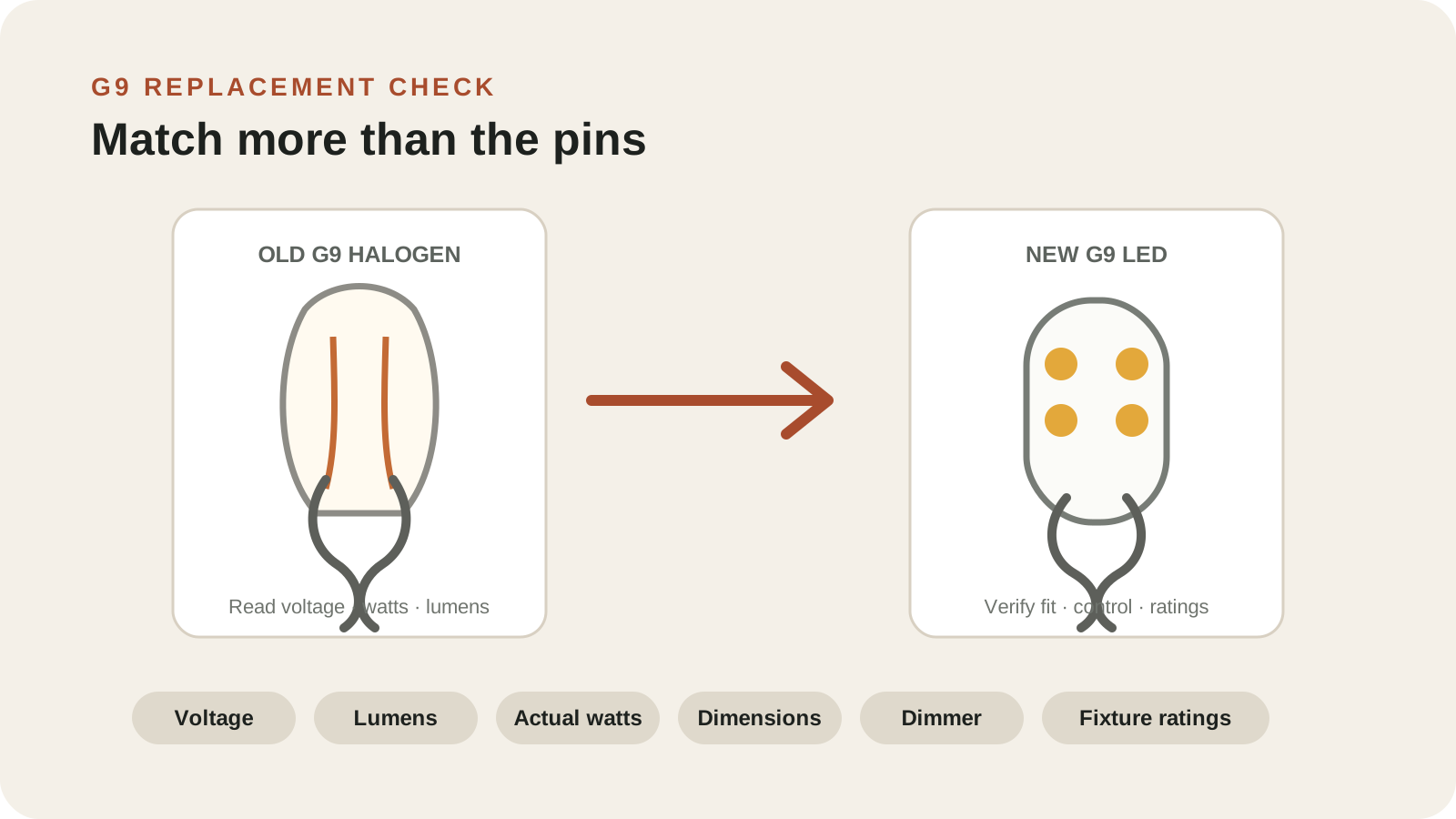
Match voltage and clearance first. Two official 120 V G9 examples show why a 40-watt replacement claim still leaves actual watts, dimensions, dimming, and enclosure ratings to check.
Reference table
Two 120 V G9 LEDs labeled as 40 W replacements
These U.S.-catalog examples explain what to compare; they are not universal replacements or suitable for a 220–240 V supply. Recheck the exact model and fixture instructions. On a phone, swipe sideways for both models.
| Check | Feit BPG940/830/LED | Westinghouse 5164100 |
|---|---|---|
| Base / rated voltage | G9 / 120 V | G9 / 120 V |
| Actual input | 4.5 W | 5 W |
| Brightness / color | 500 lm / 3000 K | 500 lm / 3000 K |
| Published dimensions | 2.2 in long × 0.8 in wide | 2.13 in maximum overall length; 3/4 in diameter |
| Dimmable | Yes; verify the dimmer combination | Yes; verify the dimmer combination |
| Enclosed fixtures | Manufacturer lists Yes | Manufacturer lists Yes |
| Moisture marking | Damp | Approved Damp; follow the separate outdoor-fixture instructions |
Codes identify one part of the lamp. The fixture label and exact model specifications still control.
Start with the old G9 lamp and fixture label
Switch off power and let the halogen capsule cool completely before handling it. Photograph every marking on the lamp and fixture, including voltage, actual watts, and any model code. A G9 base has two U-shaped wire loops with nominal 9 mm center-to-center spacing and normally pulls straight out; it is not the twist-lock connection used by GU10.
The letters and pin spacing identify the connection, not a complete electrical specification. G9 products exist in different markets and operating conditions, so a lamp that physically enters the socket can still have the wrong voltage or dimensions. If the lamp marking is unreadable, use the fixture model and manufacturer documentation instead of guessing from appearance.
Inspect the socket while the power is off. Discoloration, cracking, loose contacts, a burned smell, or damaged wiring is a fixture problem rather than a bulb-selection problem. Stop and have the fixture assessed instead of using a new lamp as a test device.
Match voltage first and actual watts second
The replacement LED must carry the voltage rating required by the fixture and supply. Do not assume that every G9 is 120 volts: G9 describes the base geometry, while voltage is a separate marking. Current U.S. manufacturer examples may be rated 120 V, but that market observation cannot establish the requirement for an unmarked fixture.
After voltage, compare the LED's actual input wattage with the fixture's maximum-wattage label and follow any stated lamp-type restriction. A package might call a 4.5-watt LED a 40-watt replacement; the smaller number is its electrical input, while the larger number is a brightness comparison. The Federal Trade Commission recommends using lumens to compare light output rather than treating watts as brightness.
Lower LED input generally means less energy is consumed by the lamp, but it does not override fixture instructions. A fixture may impose requirements involving lamp shape, heat, controls, or intended technology in addition to its wattage ceiling.
Choose lumens and color rather than equivalent watts alone
Use the old lamp's stated lumens when available. If only a replacement claim is printed, treat it as an approximate shopping category and confirm the candidate LED's actual lumen value. Official G9 catalogs show that models sharing the same base can have different light output, actual power, and claimed halogen equivalence.
Color temperature changes the appearance of the room. A value around 2700 K is commonly sold as warm white, while 3000 K appears somewhat crisper; names vary, so compare the Kelvin number. In a multi-lamp chandelier or vanity, use the same model where practical to avoid visible differences in color, brightness, startup, and dimming behavior.
Clear halogen capsules emit light in many directions. Some LED replacements distribute light differently because of their chips, diffuser, or body. For an exposed decorative fixture, inspect the manufacturer's product image and beam or distribution information instead of assuming identical sparkle or shadow patterns.
What the two 40 W replacement examples show
Feit BPG940/830/LED and Westinghouse 5164100 both list 500 lumens and 3000 K at 120 V. Their actual input differs: 4.5 W and 5 W. Their published dimensions differ too. The shared replacement claim does not make the two bodies identical or establish clearance inside your fixture.
Both manufacturers list enclosed-fixture suitability and dimming, but neither listing approves every fixture or dimmer. Westinghouse separately qualifies outdoor use in its installation notes. Read those instructions rather than treating a damp-location entry as unconditional wet-location approval.
If the old capsule says 220–240 V, neither 120 V example in this table is a match. Find a documented replacement for that voltage and compare its lumens and dimensions on their own terms.
Measure the LED before closing the shade
A G9 LED is not guaranteed to have the same width or length as a G9 halogen. Its driver, LED packages, protective cover, and heat-management structure occupy space. Measure the old capsule's widest point and overall length, then compare the fixture opening, usable depth, and distance to the glass shade or diffuser with the exact LED dimensions.
Manufacturer records illustrate why the comparison must be model-specific. Feit lists its 25-watt G9 halogen at 1.7 inches long and 0.6 inch wide, while current LED replacements in official catalogs use their own dimensions. Neither example defines every G9 lamp, and a correct base does not guarantee that a narrow sleeve or cover will close.
Do not force the lamp through a retaining ring, bend its loops, or reinstall a cover that presses against the capsule. If the LED fits the socket but not the enclosure, select a smaller documented model or follow the fixture manufacturer's replacement recommendation.
Check the dimmer, enclosure, and location ratings
For a plain on/off switch, a suitable dimmable or non-dimmable LED can operate at full output. For a conventional dimmer, the LED must explicitly be dimmable and the bulb-and-control combination must be compatible. Halogen dimmers can have load ranges or waveforms that do not suit every LED driver, causing flicker, buzzing, poor startup, dropout, or a limited dimming range.
A small sealed globe can trap heat around the LED electronics. Use an LED in a fully enclosed fixture only when the exact lamp is approved for that condition and the fixture permits it. The Department of Energy advises checking product information for enclosed-fixture suitability because excess heat can affect LED performance and life.
Dry, damp, and wet-location ratings address moisture, not heat. A damp rating does not prove enclosed-fixture suitability, and an enclosed-fixture rating does not prove outdoor suitability. Match both lamp and fixture requirements to the actual location, especially around bathrooms, cooking areas, and covered exterior fittings.
- Confirm the LED is explicitly marked dimmable before using it on a dimmer.
- Check a manufacturer compatibility list using the exact bulb and dimmer models.
- Require an explicit enclosed-fixture rating for a sealed globe or cover.
- Match dry, damp, or wet-location requirements independently.
Install and test the replacement safely
With the power off, insert the LED according to the fixture instructions without twisting it like a GU10. Make sure it is fully seated and does not contact the shade. Restore power and check startup, steady operation, color, and brightness; on a compatible dimmer, test the useful range without repeatedly rapid-cycling the lamp.
Switch the fixture off if the LED flickers on a normal switch, produces a burning odor, shows discoloration, or becomes involved with a damaged socket. Those symptoms call for checking the lamp, connection, and fixture documentation, not moving to a higher-wattage replacement. Keep the old lamp details and the new model number so the next replacement can be verified rather than rediscovered.
Before you buy
A quick replacement check
- Confirm the old lamp really has a G9 loop-pin base.
- Match the marked voltage to the fixture and electrical supply.
- Use actual watts for the fixture limit and lumens for brightness.
- Compare the LED's width and length with the opening and cover clearance.
- Use a dimmable LED only with a compatible dimmer and supported load.
- Verify enclosed-fixture approval when the shade or globe traps heat.
- Match the required dry, damp, or wet-location rating separately.
Common follow-ups
Questions people ask next
Can any G9 halogen bulb be replaced with a G9 LED?
No. The G9 base may fit, but the LED must also match voltage, brightness, physical clearance, fixture instructions, controls, and environmental ratings. Check the exact lamp and fixture specifications.
What LED replaces a 40-watt G9 halogen bulb?
Choose by the old lamp's lumens when available, then confirm the LED's voltage and dimensions. A 40-watt-equivalent claim is only a brightness category and does not establish fit, dimming, or fixture approval.
Why does my new G9 LED flicker on a dimmer?
The LED may be non-dimmable or incompatible with the installed control, load, or trim settings. Check the exact lamp and dimmer models in manufacturer compatibility guidance rather than relying only on generic LED labels.
Can a G9 LED be used inside a closed glass shade?
Only when the exact LED is approved for fully enclosed fixtures and the fixture instructions permit it. A lower actual wattage does not by itself establish enclosed-fixture suitability.
Will a G9 LED be the same size as a G9 halogen?
Not necessarily. G9 specifies the base, not the capsule width or overall length. Compare the exact manufacturer's dimensions with the fixture opening and internal clearance.
Checked against
Sources
- Manufacturer documentFeit Electric — 40W Replacement Dimmable Warm White G9 Base T4 Specialty LED ↗Accessed 2026-09-10
- Manufacturer documentWestinghouse Lighting — 5 Watt 40 Watt Equivalent G9 Dimmable LED Light Bulb ↗Accessed 2026-09-10
- Public guidanceFederal Trade Commission — Shopping for Light Bulbs ↗Accessed 2026-09-10
- Manufacturer documentFeit Electric — 25W Dimmable G9 Halogen Light Bulb ↗Accessed 2026-09-10
- Public guidanceU.S. Department of Energy — Purchasing Energy-Efficient Light Bulbs ↗Accessed 2026-09-10
- Manufacturer documentLutron Electronics — LED Compatibility Tool ↗Accessed 2026-08-26
- Public guidanceU.S. Consumer Product Safety Commission — Home Electrical Safety Checklist — Check Lights ↗Accessed 2026-09-08
- Manufacturer documentUL — Luminaires Marking and Application Guide — Environmental Location Markings ↗Accessed 2026-09-08