Bulb base guide
G9 bulb voltage, dimensions, and fixture checks
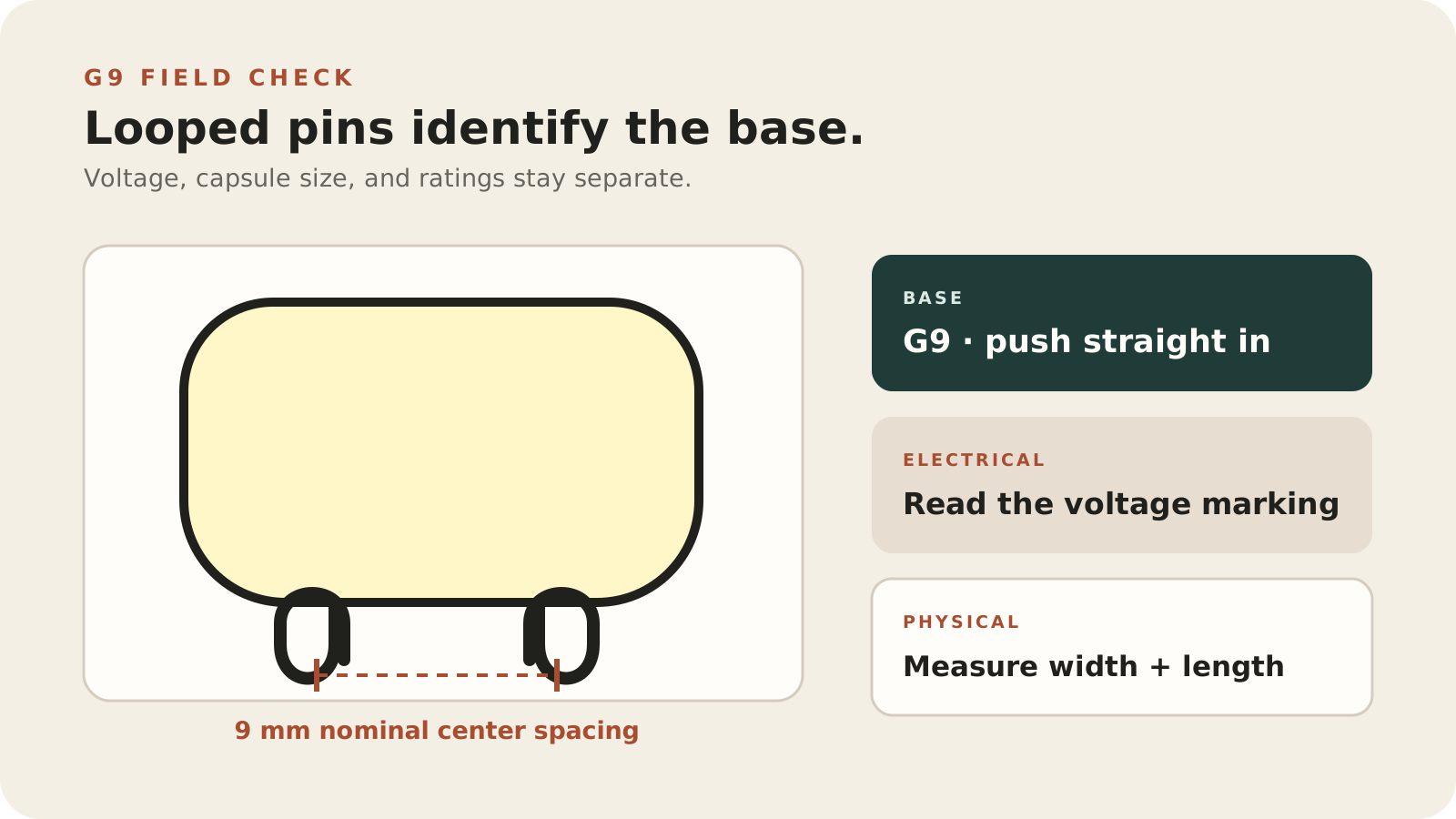
A G9 bulb is easy to recognize by its two wire loops, but the base code alone cannot tell you the voltage, capsule size, brightness, or whether an LED will work in the fixture.
Reference table
What the G9 code tells you
Treat G9 as the first field in a replacement specification, then confirm every remaining field on the exact lamp.
| Check | G9 establishes | Check separately |
|---|---|---|
| Connection | Two looped contacts; push-in base | Socket condition and insertion instructions |
| Nominal spacing | 9 mm center to center | Exact capsule width and overall length |
| Voltage | Not encoded by G9 | Lamp and fixture voltage marking |
| Brightness | Not encoded by G9 | Lumens on the exact model |
| Controls | Not encoded by G9 | Dimming, sensor, and switch compatibility |
| Environment | Not encoded by G9 | Enclosure and dry/damp/wet ratings |
Codes identify one part of the lamp. The fixture label and exact model specifications still control.
How to identify a G9 bulb
Turn off power and let the old lamp cool before touching it. At the bottom of a G9 capsule, look for two wire contacts bent into narrow U-shaped loops. They do not have the straight needle-like pins of a G4 bulb, and they do not have the widened twist-lock ends of a GU10 base.
The 9 in G9 refers to nominal center-to-center spacing in the base system. Measure from the center of one loop to the center of the other, not from the two outside edges. The applicable NEMA lamp-base standard is the dimensional framework; a ruler check is useful for identification, but a legible G9 marking is stronger evidence than a visual estimate.
G9 commonly appears on compact T4 or JCD-style capsules used in sconces, vanity lights, chandeliers, pendants, and other small decorative fixtures. Fixture type is only a clue. A similar-looking capsule can use another connection, so record the full marking before discarding the old lamp.
G9 does not specify voltage
Do not choose a replacement from the base code alone. G9 identifies the physical connection, while voltage identifies the electrical supply for which the lamp was designed. Official Feit Electric G9 examples sold for U.S. fixtures are marked 120 V, but that observation is not a universal rule and must not replace the fixture label.
Compare the voltage printed on the old lamp with the fixture or luminaire documentation. If they disagree, stop and identify the fixture model rather than guessing. A lamp with the correct loops can still be electrically unsuitable, and the base fitting into the socket is not evidence that the voltage is correct.
Also use the lamp's actual input wattage when checking the fixture's maximum-wattage limit. An LED replacement or equivalent-watt statement is about light-output comparison; it does not change the electrical figure that belongs in the fixture-limit check.
Measure the capsule before changing to LED
G9 LED replacements can be wider or longer than the original halogen capsule because the LEDs, driver components, heat-management structure, and protective cover need space. A bulb may have the correct base yet prevent a glass shade from closing or touch a diffuser once installed.
Measure the old lamp's maximum width and overall length, then measure the fixture opening and usable internal depth. Compare those measurements with the replacement manufacturer's product dimensions. Current official examples show why the model matters: Feit's 25-watt T4 G9 halogen is listed at 1.7 inches long and 0.6 inch wide, but those dimensions are not a template for every G9 lamp.
Never force a capsule through a retaining ring or reinstall a cover that presses against it. Follow any stated orientation and clearance instructions. If the fixture uses clips, sleeves, or a narrow glass cylinder, inspect those points as well as the space around the widest part of the lamp.
Match brightness in lumens
G9 bulbs are sold at many wattages and light outputs. The code does not mean 25 watts, 40 watts, or any fixed brightness. Official catalog examples include a 25-watt halogen at 230 lumens and other G9 lamps with different input and output values. Use those as model-specific facts, not as a conversion rule.
For an LED replacement, compare lumens with the old lamp or the fixture's lighting requirement. The Federal Trade Commission explains that lumens measure brightness while watts measure energy use. Color temperature, stated in kelvins, changes whether the light looks warmer or cooler; it does not determine base fit.
Small decorative fixtures often expose the lamp, so also compare the physical appearance, diffusion, clear or frosted finish, and color rendering when those qualities matter. Complete compatibility comes first; visual preference comes after the base, voltage, wattage, and clearance checks.
Dimming and enclosed fixtures are separate ratings
A dimmable G9 lamp must still be compatible with the exact dimmer or electronic control. Halogen and LED loads behave differently, and a generic dimmable label does not guarantee the expected range with every controller. Lutron and other control manufacturers publish model-specific compatibility information; use it when available.
A small globe or sealed decorative cover can trap heat. The Department of Energy advises checking the package or technical specification for explicit enclosed-fixture approval because elevated temperature can affect some LED lamps' performance and life. Do not infer this rating from G9, from LED technology, or from the fact that the old halogen operated behind a cover.
Moisture suitability is another field. Dry, damp, and wet-location markings address exposure to moisture, not heat entrapment. Confirm the lamp and fixture ratings required by the actual location, particularly in bathrooms, covered outdoor areas, and range-adjacent decorative fixtures.
Installing a G9 without damaging the loops
Photograph the old lamp, socket, fixture label, and any control model before shopping. Search the complete lamp code when it is legible. If a seller's title omits voltage, dimensions, or an enclosure rating, open the official specification instead of treating the omission as approval.
Install only after the electrical and physical checks agree. Avoid touching a new quartz halogen capsule with bare fingers when its manufacturer warns against it, and allow any existing halogen lamp to cool completely. Push a G9 lamp in according to the fixture instructions; do not twist it like a GU10 or bend the loops to make a questionable socket fit.
- Match the G9 loop-pin connection.
- Match the marked voltage exactly.
- Compare actual input watts with the fixture limit.
- Choose brightness in lumens and light appearance in kelvins.
- Verify width, length, cover clearance, dimming, enclosure, and location ratings.
Before you buy
A quick replacement check
- Switch off power and allow the old capsule to cool.
- Confirm two G9 wire loops and record the full old-lamp marking.
- Match the lamp voltage to the fixture documentation.
- Use actual input watts for the fixture limit and lumens for brightness.
- Compare published width and overall length with the fixture opening and cover.
- Verify dimmer or electronic-control compatibility for the exact LED model.
- Require explicit enclosed-fixture and location ratings where applicable.
Common follow-ups
Questions people ask next
Is a G9 bulb always 120 volts?
No. G9 identifies the loop-pin base, not voltage. Many current U.S. examples are 120 V, but the old lamp and fixture label must establish the correct voltage.
Are G9 and G4 bulbs interchangeable?
No. G9 uses looped contacts with nominal 9 mm spacing; G4 uses two straight pins with nominal 4 mm spacing. Voltage and capsule dimensions may differ as well.
Can I replace a G9 halogen with an LED?
Often, if the LED matches the base and voltage, fits the available space, stays within fixture limits, and carries the needed dimmer, enclosure, and location ratings.
How do I remove a G9 bulb?
Switch off power, let the lamp cool, and follow the fixture instructions. G9 is normally a straight push-in connection, so it is not removed with the twist used for GU10.
Does G9 tell me the bulb's dimensions?
It gives the nominal base spacing, not capsule width or overall length. Compare the exact manufacturer's dimensions when clearance is limited.
Checked against
Sources
- Standard / definitionNational Electrical Manufacturers Association — ANSI C81.61—Electric Lamp Bases, Contents and Scope ↗Accessed 2026-08-26
- Manufacturer documentFeit Electric — 25W Dimmable G9 Halogen Light Bulb ↗Accessed 2026-08-26
- Manufacturer documentBulbrite — 20W T4 JCD Halogen Clear G9 ↗Accessed 2026-08-26
- Public guidanceU.S. Department of Energy — Purchasing Energy-Efficient Light Bulbs ↗Accessed 2026-08-26
- Public guidanceFederal Trade Commission — Shopping for Light Bulbs ↗Accessed 2026-08-26
- Manufacturer documentLutron Electronics — LED Compatibility Tool ↗Accessed 2026-08-26