Bulb bases and compatibility
E12 vs E14: a two-millimeter difference that matters
These small screw bases differ by only 2 millimeters, but that is enough to make them different fittings.
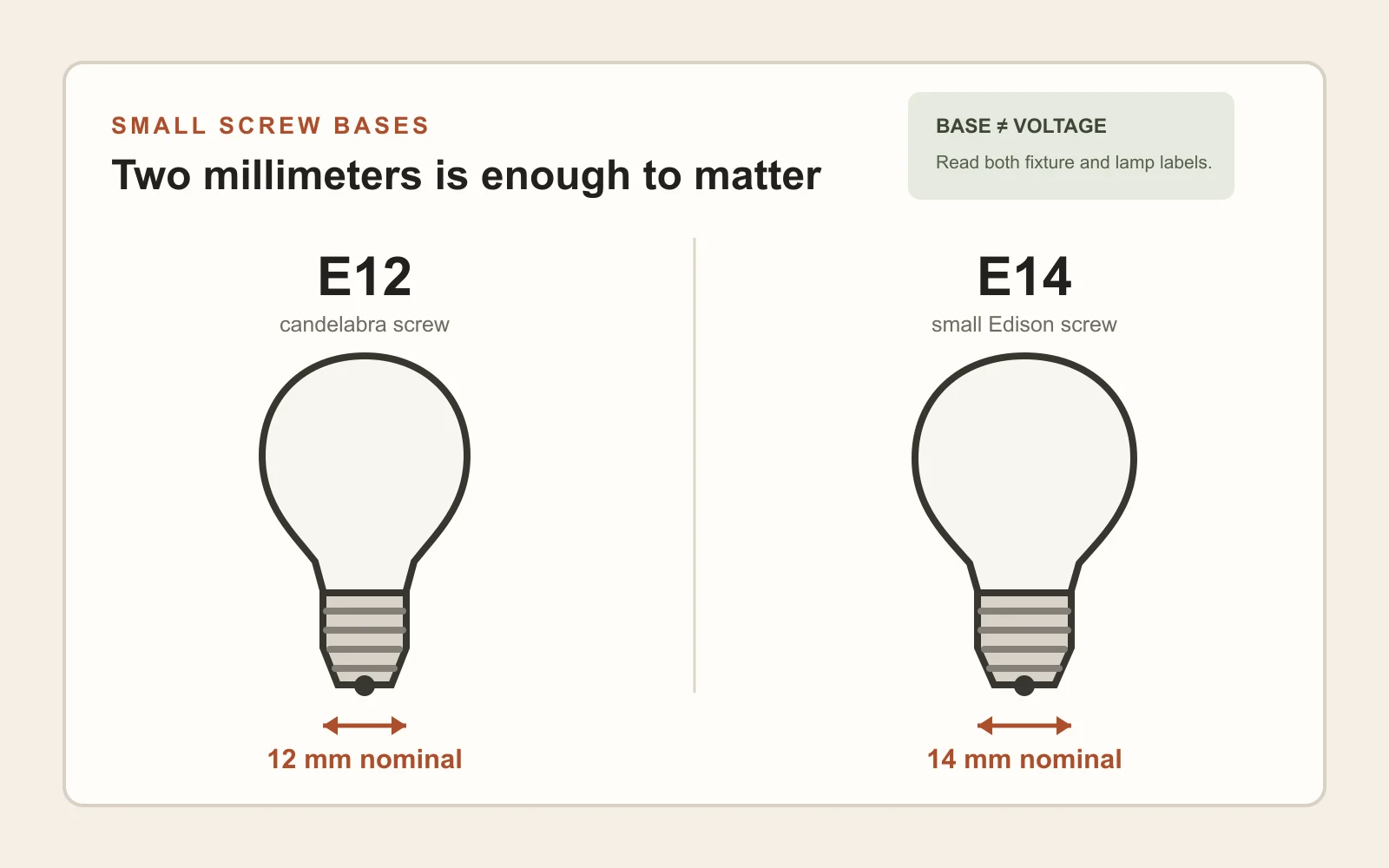
The difference is the screw-base diameter
The E in E12 and E14 identifies an Edison screw base. The number describes the nominal diameter of the threaded base in millimeters: about 12 mm for E12 and 14 mm for E14. That measurement applies to the connection, not the widest part of the glass or plastic bulb envelope.
Two millimeters sounds minor, but it is enough to create a different standardized fitting. An E14 lamp should not enter an E12 holder correctly, and an E12 lamp will not make the intended contact in an E14 holder. Do not force the threads, bend the socket contact, or treat a partly threaded lamp as a successful fit.
When the marking is unreadable, switch off and unplug the fixture when practical, let the lamp cool, and measure straight across the widest part of the metal threads. A caliper is clearer than measuring around the circumference. Also photograph the fixture label and old lamp before discarding either one.
- E12: nominal 12 mm Edison screw base.
- E14: nominal 14 mm Edison screw base.
- Measure the threaded base straight across, not around it.
The base code does not tell you the voltage
E12 is commonly called a candelabra base in North America, while E14 is common in many European and imported fixtures. Those market patterns are useful clues, but neither code is a voltage rating. Voltage must be read from the fixture, lamp, packaging, or manufacturer documentation.
Current manufacturer records show why the shortcut fails. The cited Feit E12 specialty LED is rated 120 V, which fits the familiar North American pattern. Bulbrite also lists an E14 incandescent lamp rated 130 V. That E14 example is sold by a U.S. manufacturer and directly disproves the idea that every E14 lamp must be a 220–240 V product.
Start with the fixture supply and holder marking, then choose a lamp carrying the same base code and an appropriate rated voltage. If an imported fixture has no readable electrical label or reliable model documentation, stop rather than guessing from the socket size.
- Base code identifies the mechanical and electrical contact interface.
- Voltage is a separate model-level specification.
- Country of sale is context, not proof of compatibility.
Base and bulb shape are separate decisions
A small screw base can appear under several bulb shapes. North American E12 products include familiar chandelier, flame-tip, globe, and tubular lamps. E14 products are also sold in chandelier, globe, and other compact forms. Words such as chandelier or torpedo describe the bulb body or intended appearance; they do not replace the exact E12 or E14 marking.
The LEDVANCE base guide lists E12 and E14 as separate screw-in designs. It also treats the base system separately from envelope names and dimensions. This matters because two lamps can share an E12 base while having different maximum diameters, overall lengths, and tip shapes.
Measure the old lamp at its widest point and from the base contact to the top. Check space around shades, clips, glass covers, and decorative sleeves. An LED replacement may have a wider neck or electronics near the base even when its visible envelope resembles the old incandescent lamp.
- Copy the full base code before comparing bulb shapes.
- Measure maximum diameter and overall length separately.
- Confirm clearance for covers, shades, clips, and sleeves.
Match brightness, power, and light color separately
Once the base, voltage, and physical fit are correct, compare the light itself. Lumens describe light output, while watts describe electrical input. The U.S. Department of Energy recommends using lumens when comparing brightness because an efficient LED can produce similar light with much less power than an incandescent lamp.
Use the LED's actual wattage when checking the fixture's maximum lamp wattage. A package phrase such as “40 W replacement” is a brightness comparison, not the LED's input power. Stay at or below the fixture limit and do not assume that a brighter lamp is suitable merely because its base fits.
Kelvin describes the appearance of white light. A 2700 K lamp looks warm, while a higher value generally looks cooler. Match the old Kelvin value when you want the room or chandelier to retain its previous character, but keep Kelvin separate from lumens and wattage.
- Lumens compare brightness.
- Actual watts count toward the fixture limit.
- Kelvin describes light appearance, not brightness.
Dimming and fixture conditions still control
A correct E12 or E14 base does not establish dimmer compatibility. The replacement must be explicitly marked dimmable, and the lamp manufacturer may publish a compatible-control list. A non-dimmable LED should not be placed on a dimmer simply because the old incandescent lamp dimmed normally.
Enclosed-fixture, damp-location, wet-location, and temperature claims are also independent. Decorative fixtures often have small shades or glass covers that retain heat. Use an LED approved for the actual enclosure and location, and follow any limits in the fixture instructions.
Appliance and specialty fixtures may add heat, vibration, or model-specific requirements. In those cases, use the fixture or appliance model number to find the specified replacement instead of choosing from base size alone.
- Look for an explicit dimmable claim on the exact lamp.
- Check enclosure and location ratings independently.
- Use model instructions for appliance and specialty fixtures.
If the marking and measurement disagree
Work from the fixture outward. First confirm E12 or E14 on the old lamp and holder, then confirm supply voltage and the replacement's voltage range. Next check actual watts, dimensions, lumens, Kelvin, dimming, and environmental ratings. This order prevents a familiar shape or attractive light output from hiding a connection mismatch.
Avoid using an E12-to-E14 or E14-to-E12 adapter as a default solution. An adapter adds length, moves the light source, and may change clearance and heat around the socket. Use one only when the fixture and adapter manufacturers explicitly support that combination and all electrical ratings remain correct.
If the base label and measurement disagree, do not force a trial fit. Recheck the measurement, search the fixture model, or take the old lamp to a qualified lighting or electrical supplier. A replacement that matches every visible feature except the full base code is still the wrong replacement.
- Match base and voltage before comparing light output.
- Treat adapters as a documented exception, not a shortcut.
- Stop when labels, measurements, or fixture instructions conflict.
Before you buy
A quick replacement check
- Copy E12 or E14 from the old lamp, holder, or fixture label.
- Measure the threaded base straight across if the code is unreadable.
- Confirm the fixture supply and the replacement lamp's rated voltage.
- Stay within the fixture's maximum actual lamp wattage.
- Measure maximum bulb diameter, overall length, and cover clearance.
- Compare lumens for brightness and Kelvin for light appearance.
- Verify dimmer compatibility on the exact lamp model.
- Check enclosure, location, heat, vibration, and specialty ratings.
Common follow-ups
Questions people ask next
Can an E14 bulb fit an E12 socket?
No. E14 has a larger nominal thread diameter. Do not force it into an E12 holder or accept a partial fit; use the complete base code specified by the fixture.
Is E12 the same as a candelabra base?
In North American product language, candelabra commonly refers to E12. The printed E12 code is more precise because informal base names vary between markets.
Does E14 always mean 220–240 volts?
No. E14 identifies the base, not the voltage. For example, the cited Bulbrite E14 lamp is rated 130 V. Read the voltage on the exact lamp and fixture.
Can I use an E12-to-E14 adapter?
Only when the fixture and adapter manufacturers explicitly support the installation. An adapter changes lamp position and clearance and may affect the fixture's evaluated electrical and thermal configuration.
How can I tell E12 from E14 without packaging?
Switch off power, let the lamp cool, and measure the metal threads straight across. About 12 mm indicates E12; about 14 mm indicates E14. Confirm the result against the fixture label.
Checked against
Sources
- Manufacturer documentLEDVANCE — Guide to Light Bulb Shapes, Types, and Sizes ↗Accessed 2026-08-18
- Standard / definitionInternational Electrotechnical Commission — IEC 60061 Database — Lamp Caps and Holders ↗Accessed 2026-08-18
- Manufacturer documentFeit Electric — 1.2W Warm White E12 Base T6 Specialty LED ↗Accessed 2026-08-18
- Manufacturer documentBulbrite — 25W B10 Torpedo Clear E14 130V ↗Accessed 2026-08-18
- Manufacturer documentIKEA Singapore — SOLHETTA LED Bulb E14 250 Lumen ↗Accessed 2026-08-18
- Public guidanceU.S. Department of Energy — Purchasing Energy-Efficient Light Bulbs ↗Accessed 2026-08-18