Bulb Wattage and Compatibility
How Many Watts Does an A19 LED Use? 40W–100W Compared
Most household A19 LEDs draw about 5–18 watts, but lumens—not replacement wattage—tell you how much light you will get.
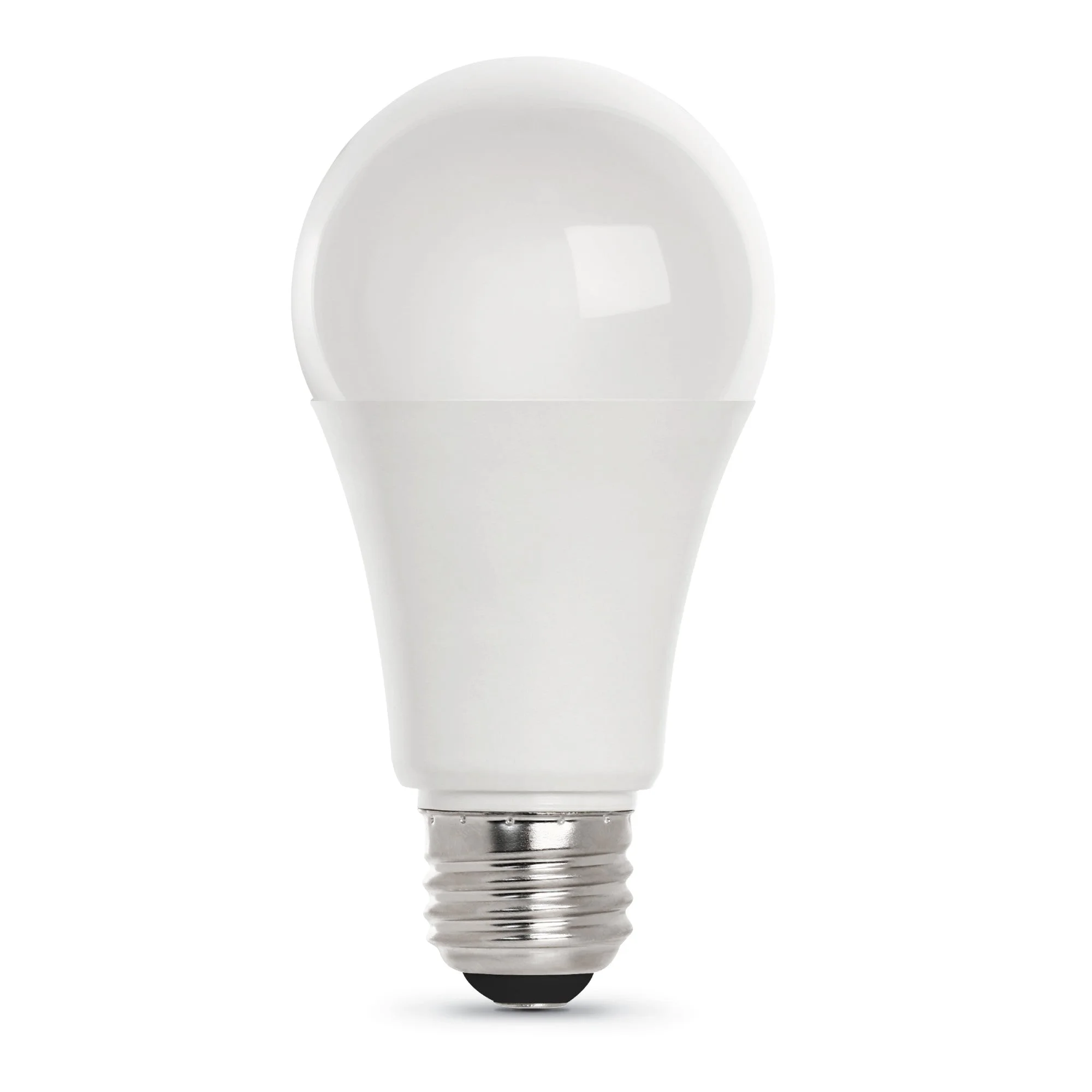
The short comparison
The U.S. Department of Energy’s comparison for general-purpose A-type LED bulbs with E26 bases places the full 40W-to-100W replacement range at approximately 4.5–18 watts. The familiar 40W, 60W, 75W, and 100W descriptions refer to incandescent-equivalent light output; they are not the electricity drawn by the LED.
Current manufacturer specifications illustrate why a range is more accurate than a single conversion. In the limited official catalog sample reviewed here, Philips A19 lamps span 5 watts at 450 lumens through 14 watts at 1,500 lumens. A Feit Electric adjustable-output A19 uses 5, 8.8, 12.2, or 16 watts at its four brightness settings.
- 40W replacement: Look around 450 lumens. DOE’s reference range is 4.5–7 LED watts; current Philips examples use 5 watts.
- 60W replacement: Look around 800 lumens. DOE’s range is 5.9–10.5 watts; current Philips and Feit examples use 8.8 watts.
- 75W replacement: Look around 1,100 lumens. DOE’s range is 9.5–14 watts. The Philips bulletin includes 11- and 12.2-watt lamps at 1,100 lumens, as well as 10-watt lamps labeled 75W equivalent at 1,000 lumens.
- 100W replacement: Look around 1,500–1,600 lumens in the current manufacturer sample. DOE uses 1,600 lumens and a 10.5–18-watt range; Philips lists 14-watt, 1,500-lumen models, while Feit examples include 15 watts at 1,500 lumens and 16 watts at 1,600 lumens.
Why equivalent watts and actual watts are different
Watts measure power input. Lumens measure emitted visible light. An LED can therefore provide approximately the light associated with an old 100-watt incandescent while drawing only 14, 15, 16, or another much lower number of watts.
On the package, read “Energy Used” or the wattage specification to find the actual electrical load. Read “Brightness” to find lumens. The FTC Lighting Facts label also reports expected life, light appearance, and estimated energy cost. The large replacement-wattage statement is a familiar brightness comparison, but it should not replace the lumen or actual-wattage figures when making a technical decision.
Equivalent labels are not perfectly interchangeable across every product. The current examples include 100W replacements at both 1,500 and 1,600 lumens, and Philips lists some 75W replacements at 1,000 lumens while others produce 1,100. If matching an existing room’s brightness matters, compare lumens directly rather than assuming every bulb with the same equivalent-watt label will look equally bright.
A19, E26, and 120 volts describe different things
A19 is the bulb shape and nominal size. The “A” identifies the familiar pear-like general-purpose form, while “19” represents a nominal diameter of 19 eighths of an inch, or about 2⅜ inches. It does not identify the screw base, operating voltage, brightness, or wattage.
E26 is a base designation for a medium screw base with a nominal 26-millimeter thread diameter. A19 and E26 often appear together in U.S. household bulbs, including the manufacturer examples reviewed here, but they answer different compatibility questions: A19 describes the envelope, and E26 describes the connection to the socket.
Voltage is a separate electrical specification. The Philips and Feit A19 examples cited here are rated for 120 volts, but the A19 shape alone does not guarantee that voltage. Match the voltage printed on the replacement bulb to the fixture or circuit documentation.
Physical clearance is separate again. A nominal A19 diameter does not guarantee that every LED has the same overall length or the same width around its driver housing. One Feit 15-watt A19, for example, is listed at 4.6 inches long and 2.4 inches wide. Measure a tight globe, shade, harp, or socket recess and compare the candidate bulb’s published dimensions.
How the fixture’s wattage label applies
The fixture’s maximum-wattage label remains the controlling limit. The Consumer Product Safety Commission advises using the correct bulb wattage and notes that fixtures commonly identify both the permitted lamp type and the highest safe wattage.
For an LED, compare that limit with the bulb’s actual input wattage—not the incandescent-equivalent number on the front of the package. A 14-watt LED labeled “100W replacement” has a 14-watt electrical input. In a fixture marked for a maximum 60-watt lamp, 14 watts is below that numerical wattage ceiling.
That comparison does not cancel other instructions. A fixture label may restrict bulb type, shape, orientation, or installation conditions. Its socket, wiring, shade, insulation, and ventilation were evaluated as a system. Follow the complete fixture label and model documentation, especially if they give a specific LED limit or prohibit a particular lamp type. If the label is missing, damaged, or ambiguous, identify the fixture model or ask its manufacturer rather than guessing.
Dimmers and enclosed fixtures require separate checks
“Dimmable” is a property of the bulb’s driver, not a consequence of being an A19 LED. Some Philips and Feit examples are dimmable and others are not. If a fixture is controlled by a dimmer, the bulb must be labeled dimmable, and the bulb and dimmer models should appear in a manufacturer compatibility resource when possible. A dimmable label alone does not promise ideal operation with every dimmer.
Enclosure suitability is another independent rating. Fully enclosed fixtures retain heat, which can affect LED performance and life. Use a bulb whose package or technical specification explicitly permits enclosed-fixture operation. Do not treat a damp-location rating as an enclosure rating: moisture exposure and trapped heat are different conditions.
The exact model matters here. Feit’s 15-watt, 1,500-lumen A19 product page separately lists it as non-dimmable, damp-location rated, and suitable for enclosed fixtures. Those three entries should not be collapsed into one general compatibility claim for all Feit bulbs or all A19 LEDs.
A reliable label-reading method
Start with the brightness you want, using about 450, 800, 1,100, or 1,600 lumens as practical reference points for traditional 40W, 60W, 75W, or 100W light levels. Then confirm the actual watts and every fixture-specific requirement.
Color temperature changes the appearance of the light rather than its wattage-equivalent category. Current Philips 14-watt, 1,500-lumen A19 models, for example, are offered at several color temperatures while retaining the same power and lumen specifications. Choose color appearance only after the electrical and physical checks are satisfied.
Finally, retain the packaging or specification sheet. It records the exact model’s wattage, voltage, dimmability, enclosure suitability, location rating, dimensions, and other limitations more reliably than the broad phrase “A19 LED.”
Before you buy
A quick replacement check
- Choose brightness by lumens, not by the replacement-wattage headline.
- Compare the fixture limit with the LED’s actual input wattage.
- Match the socket’s base code, commonly E26 for U.S. A19 bulbs.
- Match the bulb voltage to the fixture or circuit documentation.
- Verify dimmability and the specific dimmer-bulb combination.
- Confirm enclosed-fixture suitability separately from damp- or wet-location ratings.
- Check overall bulb dimensions and clearance around the shade, globe, or socket.
- Follow the exact fixture label and model instructions when they are more restrictive.
Common follow-ups
Questions people ask next
Can I use a 100W-equivalent A19 LED in a fixture marked 60W maximum?
Often the LED’s actual input is only about 11–18 watts, so it may fall below the numerical 60-watt limit. However, the complete fixture label still controls; verify permitted lamp type, enclosure conditions, voltage, and physical fit.
Does every 100W-equivalent A19 LED use the same wattage?
No. DOE gives a broad 10.5–18-watt reference range at 1,600 lumens, while current manufacturer examples include 14-, 15-, 16-, and 17.5-watt products with differing specifications.
Is an A19 bulb always an E26, 120-volt bulb?
No. A19 describes shape and nominal diameter. E26 describes the base, and 120 volts is an electrical rating. Check all three specifications independently.
Is a damp-rated LED automatically approved for an enclosed fixture?
No. A location rating addresses moisture exposure, while an enclosed-fixture rating addresses operation where heat can be trapped. Look for both specifications when both conditions apply.
Checked against
Sources
- U.S. Department of Energy, Federal Energy Management Program — Purchasing Energy-Efficient Light Bulbs ↗Accessed 2026-08-12
- U.S. Federal Trade Commission — The FTC “Lighting Facts” Label: Questions and Answers for Manufacturers ↗Accessed 2026-08-12
- Signify — Philips A19 LED Lamps Bulletin PLt-2407BN 04/26 ↗Accessed 2026-08-12
- Feit Electric — 15W (100W Replacement) Soft White A19 General Purpose LED ↗Accessed 2026-08-12
- Feit Electric — All-in-One Adjustable Brightness Adjustable White LED Light Bulb ↗Accessed 2026-08-12
- LEDVANCE — E26 vs. A19: Difference Explained ↗Accessed 2026-08-12
- Feit Electric — What Dimmers Are Compatible with Feit Electric Dimmable Lights? ↗Accessed 2026-08-12
- U.S. Consumer Product Safety Commission — Smoke Alarms—Why, Where, and Which, CPSC Publication 559 ↗Accessed 2026-08-12