Light Bulb Buying Guides
2700K vs 3000K vs 5000K Light Bulbs: Which Color Temperature Should You Choose?
Choose 2700K for a traditional warm glow, 3000K for a cleaner warm white, or 5000K for crisp, blue-toned task lighting.
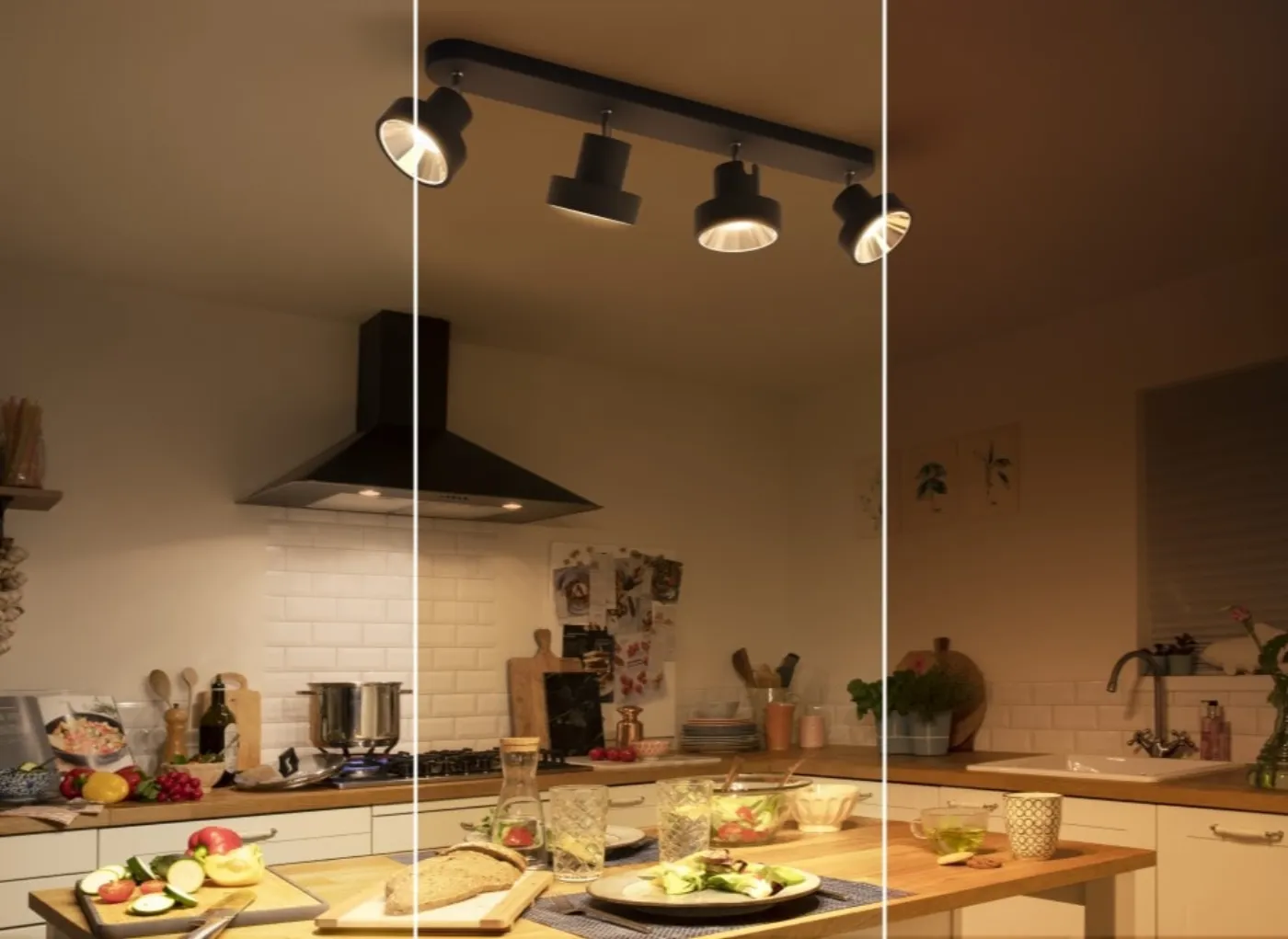
The practical difference at a glance
Correlated color temperature, or CCT, describes the apparent color of white light in kelvins. Lower values look warmer and more yellow; higher values look cooler and bluer. ENERGY STAR places 2700K and 3000K at the warm end of the scale and describes 5000K as a bluer white. The scale may feel backward at first: a higher number means cooler-looking light, not more heat or brightness.
The three choices serve noticeably different purposes. The U.S. Department of Energy characterizes 2700K as friendly and personal, with homes among its typical applications, while 3000K is warm and pleasing. A 5000K bulb is much farther toward the cool end and will stand out beside either warm option.
- 2700K: familiar, yellowish warm white similar in appearance to a conventional incandescent bulb.
- 3000K: still warm, but a little whiter and less amber than 2700K.
- 5000K: crisp, cool white with a visibly blue component; commonly sold as daylight.
- Best default for relaxed residential rooms: 2700K.
- Best warm-but-clean compromise: 3000K.
- Best reserved for deliberate cool-white task lighting: 5000K.
Choose by room and time of use
Use 2700K where comfort and evening atmosphere matter most: bedrooms, living rooms, dens, and table or floor lamps used after dark. It complements the appearance many people expect from incandescent lighting and is less likely than 5000K to make a warm residential room feel stark. It is also the safest choice when replacing one failed bulb in a group of existing 2700K lamps.
Use 3000K when 2700K looks too yellow but 5000K would be too cool. It works well in a kitchen that opens into a warm-lit living area, a bathroom where you want a clean-looking white without a daylight-blue cast, or a home office that also serves as a guest room. DOE classifies both 2700K and 3000K as warm residential choices, so the decision between them is usually about finishes, neighboring lights, and personal preference rather than a radically different lighting category.
Use 5000K intentionally. Its cool appearance can suit a garage workbench, sewing area, laundry workspace, or other task setting, particularly during daytime. ENERGY STAR consumer guidance associates warmer light with most indoor applications and cooler or daylight choices with work and reading. That is guidance, not a rule: enough light on the task, good glare control, and suitable color rendering can matter as much as CCT.
For evening lighting, favor warm and dim
If the bulb will be used close to bedtime, 2700K is the more conservative choice; reducing its brightness in the evening is also important. A controlled study found that bright 6500K light suppressed nocturnal melatonin changes more strongly than 3000K light, but it tested only five people under unusually bright, five-hour exposures. It therefore supports a cautious direction—not a claim that any 5000K household bulb will disrupt sleep.
CCT is only a rough proxy for the spectrum reaching your eyes. Exposure level, duration, timing, distance, and the lamp’s actual spectral output all matter. For bedrooms and late-night hallways, a warm bulb at a modest level is a more useful strategy than focusing on Kelvin alone. A dimmable 2700K LED normally retains the same nominal CCT as it dims unless it is specifically described as “dim-to-warm.” DOE notes that dim-to-warm products are designed to shift toward a lower CCT as output falls.
Kelvin does not tell you brightness or color quality
Do not choose 5000K merely because you want a brighter room. Lumens measure light output, while watts measure energy use; Kelvin describes the light’s appearance. A 2700K bulb and a 5000K bulb can carry the same lumen rating. The FTC’s Lighting Facts label lists brightness, light appearance, energy use, estimated cost, and life as separate attributes.
Color rendering is separate again. CRI describes how colors shift under a source compared with an appropriate reference source of similar color temperature. Two 3000K bulbs can therefore make food, paint, or skin tones look different. ENERGY STAR’s downlight criteria, for example, specify CCT and CRI independently. When accurate color matters, compare the manufacturer’s CRI or more detailed color-rendering data in addition to Kelvin.
Also check whether the lumen value is reported at a particular CCT on a tunable bulb. A smart or switchable lamp may not produce exactly the same output at every setting. Use the product’s own specifications rather than assuming its 2700K, 3000K, and 5000K modes are equally bright.
Keep color temperature separate from physical and electrical fit
Choosing the preferred CCT does not establish that the bulb fits or is approved for the fixture. Treat each specification as its own check. DOE notes that LED lamps can be larger than incandescent lamps, particularly near the base, and that enclosed fixtures trap heat that may affect LED performance and life. It recommends verifying enclosed-fixture suitability and dimming capability on the packaging or technical specifications.
Manufacturer specifications show why these checks cannot be inferred from Kelvin or bulb technology. One current Philips selectable-color A19 separately identifies its E26 base, 120-volt input, dimming support, dimensions, and restriction against closed luminaires. Those are individual model attributes, not general properties of every bulb offered at the same Kelvin setting.
The fixture label and the bulb model’s documentation take priority over general advice. If either sets a more restrictive condition, follow it.
- Base code: Match the socket system, such as E26. Similar-looking bases are not automatically interchangeable.
- Bulb shape: Select A19, BR30, G25, candle, or another required form independently of the base.
- Voltage: Use a bulb rated for the fixture’s supply voltage; CCT says nothing about voltage.
- Fixture rating: Keep the bulb’s actual wattage within the fixture’s stated maximum and observe any required lamp type.
- Dimmer compatibility: The bulb must be dimmable, and its model should be compatible with the installed dimmer or control.
- Enclosure and location rating: Verify suitability for enclosed fixtures and for dry, damp, or wet locations as applicable.
- Physical clearance: Confirm the bulb’s complete dimensions, including its wider driver housing, fit without pressing against a shade, lens, or trim.
How to avoid a mismatched result
Within a multi-bulb fixture or an open-plan sightline, use the same nominal CCT unless you want a deliberate contrast. DOE advises matching the previous CCT because large changes are readily noticeable and can leave occupants dissatisfied. Matching the brand and model is even more reliable: products with the same nominal Kelvin value can still differ slightly in tint, output, diffusion, and dimming behavior.
Do not rely only on names such as “soft white,” “bright white,” or “daylight.” ENERGY STAR materials associate soft or warm white with roughly 2700–3000K and daylight with higher values, but the Kelvin number is the clearer comparison. If you are undecided between 2700K and 3000K, test one bulb in the actual room after sunset. Wall color, shades, daylight, and nearby lamps can change how the choice appears.
A switchable-CCT bulb or tunable-white lamp can be useful when the room serves different purposes. Set all lamps in a fixture to the same mode, and remember that a wall dimmer still requires documented compatibility even if the bulb has its own color-temperature switch.
Before you buy
A quick replacement check
- Choose 2700K for relaxed rooms and evening use, 3000K for a cleaner warm white, or 5000K for deliberately cool task light.
- Match brightness by lumens, not by Kelvin or replacement-watt language.
- Compare CRI separately when accurate object colors matter.
- Match the exact base code and required bulb shape.
- Confirm voltage and stay within the fixture’s actual-wattage limit.
- Verify dimmer or electronic-control compatibility by model.
- Check enclosed-fixture and dry, damp, or wet-location ratings.
- Measure the bulb and confirm physical clearance before buying multiples.
Common follow-ups
Questions people ask next
Is 3000K bright white or warm white?
It is generally considered warm white, although product naming varies. Compared with 2700K it looks a little cleaner and less yellow; compared with 5000K it remains distinctly warm.
Is 5000K brighter than 2700K?
Not necessarily. Compare lumens to determine brightness. Kelvin describes whether the white light looks warmer or cooler, so bulbs with different CCTs can have the same rated lumen output.
Can I mix 2700K and 3000K bulbs in one room?
Yes, but the difference may be visible, especially when bulbs illuminate the same surface or sit in one fixture. For a uniform result, use the same CCT—and preferably the same bulb model—throughout each visible group.
Which color temperature is closest to an incandescent bulb?
2700K is usually the closest of these three choices. DOE identifies most incandescent lamps as producing warm light around 2700K.
Checked against
Sources
- ENERGY STAR — Downlights Key Product Criteria ↗Accessed 2026-08-12
- U.S. Department of Energy — Purchasing Energy-Efficient Light Bulbs ↗Accessed 2026-08-12
- ENERGY STAR — Light Moment with ENERGY STAR: Table/Floor Lamp ↗Accessed 2026-08-12
- PubMed, National Library of Medicine — Effects of Lights of Different Color Temperature on Nocturnal Core Temperature and Melatonin ↗Accessed 2026-08-12
- U.S. Department of Energy — Understanding LED Color-Tunable Products ↗Accessed 2026-08-12
- Federal Trade Commission — Shopping for Light Bulbs ↗Accessed 2026-08-12
- Signify — Philips Selectable Color Filament Bulb Product Specification ↗Accessed 2026-08-12