Bulb base guide
G4 LED replacement: voltage, transformer, fit
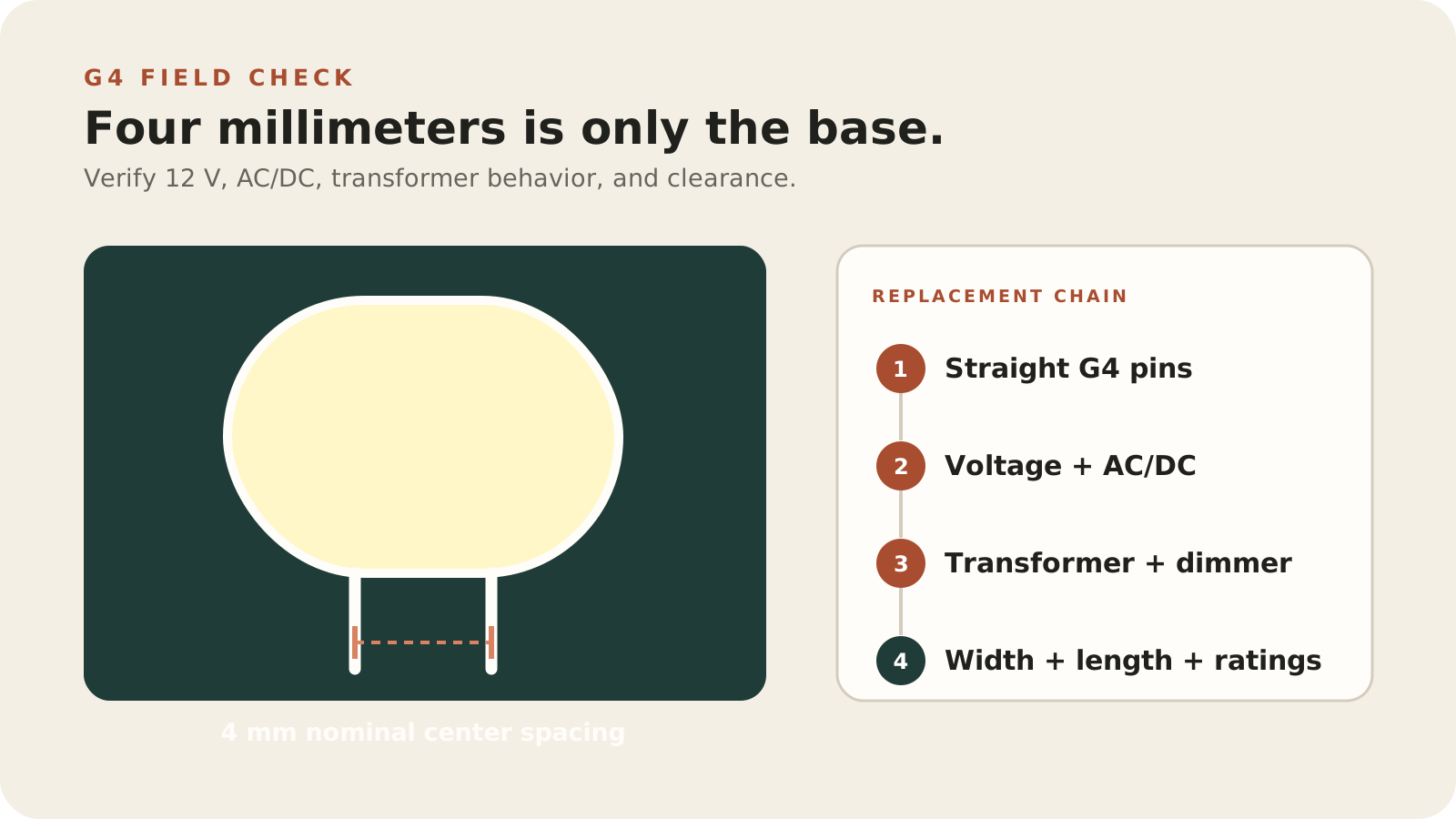
G4 identifies two closely spaced straight pins. It does not promise 12 V, a particular capsule size, or compatibility with the fixture's transformer and controls.
Reference table
What the G4 marking establishes
The base is easy to recognize, but the electrical supply and the tiny fixture envelope usually decide whether an LED replacement works.
| Check | G4 establishes | Check on the exact lamp and fixture |
|---|---|---|
| Connection | Two thin, straight pins | Socket condition and permitted pin diameter |
| Nominal spacing | 4 mm center to center | Capsule width and overall length |
| Supply | Not encoded by G4 | Voltage plus AC, DC, or AC/DC marking |
| Driver system | Not encoded by G4 | Transformer or power-supply compatibility |
| Light | Not encoded by G4 | Lumens, Kelvin value, and beam distribution |
| Ratings | Not encoded by G4 | Dimming, enclosure, and location approval |
Codes identify one part of the lamp. The fixture label and exact model specifications still control.
How to identify a G4 base
With power off and the old lamp cool, look for two thin, straight metal pins set very close together. The nominal spacing is 4 mm from the center of one pin to the center of the other. Measure center to center rather than outside edge to outside edge, because pin thickness would otherwise distort the result.
G4 is different from G9, which uses two wire loops with nominal 9 mm spacing. It is also different from GU5.3, whose straight pins are farther apart and often appear on MR16 reflectors. Do not spread, bend, trim, or force pins to make a near match enter the socket.
The small G4 connection appears on compact T3 and capsule lamps, MR11 reflectors, puck lights, under-cabinet lighting, landscape fixtures, marine and RV fittings, and some desk lamps. Those uses are identification clues, not proof of the base or voltage.
Why 12 V is common but not guaranteed
Many current G4 products for the U.S. market are designed for 12-volt systems. Feit Electric, for example, publishes G4 LEDs marked 12 V, including one specified as 12 V AC only and another 12 V model for landscape and accent lighting. Bulbrite also lists 12 V G4 halogen capsules. These model records show a common pattern, not a definition of G4.
Read the old lamp, fixture label, transformer, or power-supply documentation. Match not only the voltage number but also whether the replacement accepts AC, DC, or both. A product marked 12 V AC only should not be assumed suitable for an unspecified 12 V DC system, and the words G4 or LED do not settle that question.
If the fixture is connected directly to household line voltage, do not insert a low-voltage lamp. If the supply marking is inaccessible or ambiguous, identify the fixture and transformer model before replacing the lamp.
The transformer can matter after an LED conversion
A low-voltage fixture may use a magnetic transformer, an electronic transformer, or a regulated DC supply. An LED replacement draws much less power than the halogen lamp it replaces, and some older electronic transformers need a minimum load or have output characteristics that do not suit every LED driver. Possible symptoms include failure to start, flicker, pulsing, noise, or unstable dimming.
Look for a transformer compatibility statement from the lamp or fixture manufacturer. When several lamps share one transformer, consider their combined actual LED load and the transformer's permitted range. Do not add an arbitrary load merely to make an incompatible system behave; use components approved for the application.
Dimming adds another layer. The lamp must be dimmable, the transformer must support dimming, and the wall control must be compatible with that system. A dimmable G4 marking alone cannot establish all three conditions.
Measure a tight fixture before buying
G4 fixtures are often designed around a very small halogen capsule. An LED replacement may be wider, longer, or thicker because of its circuit board, emitters, driver, and protective cover. The pins can line up correctly while the body strikes a glass lens, reflector, socket collar, or retaining clip.
Measure the old lamp's maximum width, overall length, and distance from the pin tips to the widest point. Then measure the fixture opening, usable depth, and space around the socket. Compare those values with the exact product drawing; G4 itself provides only nominal pin spacing.
Official product pages illustrate the variation. Feit lists one 12 V G4 LED at 1.4 inches long and 0.8 inch wide, while other G4 capsules use different dimensions. Never generalize one model's envelope to the entire base family.
Choose lumens, color, and ratings separately
For brightness, compare lumens instead of the replacement-watt claim. Current official examples include a 1.5-watt LED around 90 lumens and a 2-watt LED around 135 lumens, while halogen G4 capsules at 10 or 20 actual watts have other output values. These are examples from specific models, not universal conversions.
Select color temperature in kelvins after compatibility is established. A warm or bright-white description affects appearance, not base fit. If a landscape or marine fixture is exposed to moisture, confirm the lamp and fixture's location ratings. A damp rating is not the same as a wet rating.
For a sealed puck light or covered fixture, require explicit enclosed-fixture approval when the application calls for it. The Department of Energy notes that trapped heat can affect some LED lamps. Enclosure approval, moisture rating, dimmability, voltage, and transformer support are distinct fields.
Installing the matched G4 lamp
Photograph the old lamp, fixture label, power supply, and control before removing anything. Search the complete model number when possible. A listing that says only G4 LED leaves voltage type, dimensions, brightness, transformer behavior, and ratings unresolved.
After confirming the replacement, align the pins without bending them and insert the lamp according to the fixture instructions. Do not touch a quartz halogen capsule with bare fingers when the manufacturer advises against it, and never work on a live low-voltage circuit merely because its voltage is lower than household mains.
- Match straight G4 pins and nominal 4 mm spacing.
- Match voltage and the AC/DC requirement.
- Confirm transformer and dimmer compatibility.
- Check body width, overall length, and cover clearance.
- Choose lumens and color, then verify enclosure and location ratings.
Before you buy
A quick replacement check
- Switch off power and record the full old-lamp marking.
- Confirm straight pins with nominal 4 mm center spacing.
- Match voltage plus AC, DC, or AC/DC operation.
- Identify the transformer or power supply and verify LED compatibility.
- Compare actual lamp dimensions with the fixture opening and usable depth.
- Use lumens for brightness and actual input watts for fixture limits.
- Verify dimming, enclosure, and dry/damp/wet-location requirements.
Common follow-ups
Questions people ask next
Is every G4 bulb 12 volts?
No. Twelve volts is common in current G4 products, but G4 identifies the pin base only. Match the exact voltage and AC/DC marking on the lamp and supply.
Are G4 and G9 bulbs interchangeable?
No. G4 has straight pins at nominal 4 mm spacing; G9 has looped contacts at nominal 9 mm spacing. Their voltage and envelope dimensions may also differ.
Can a G4 LED work with an old halogen transformer?
Sometimes. Check the LED and transformer documentation for load range, output type, and dimming compatibility. Low LED load can cause problems with some older electronic transformers.
Does polarity matter for a G4 LED?
It depends on the exact lamp and power supply. Follow the product's AC, DC, or polarity instructions rather than assuming all G4 LEDs behave alike.
Why does my G4 LED flicker?
Possible causes include an incompatible transformer, minimum-load behavior, an unsuitable dimmer, unstable supply, or a lamp fault. Identify the exact components before changing them.
Checked against
Sources
- Standard / definitionNational Electrical Manufacturers Association — ANSI C81.61—Electric Lamp Bases, Contents and Scope ↗Accessed 2026-08-21
- Manufacturer documentFeit Electric — 1.5W 12V T4 Shape G4 Base LED Light Bulb ↗Accessed 2026-08-21
- Manufacturer documentFeit Electric — 2W G4 Base Capsule 12-Volt Specialty LED ↗Accessed 2026-08-21
- Manufacturer documentBulbrite — 20W T3 JC Type Halogen Clear G4 12V ↗Accessed 2026-08-21
- Public guidanceU.S. Department of Energy — Purchasing Energy-Efficient Light Bulbs ↗Accessed 2026-08-21
- Manufacturer documentLutron Electronics — LED Compatibility Tool ↗Accessed 2026-08-21