Bulb Sizes and Fit
A19 vs A21 LED Bulbs: Brightness Is Not the Only Fit Question
An A21 is wider than an A19, but shape alone does not determine brightness, socket fit, electrical compatibility, or safe fixture use.
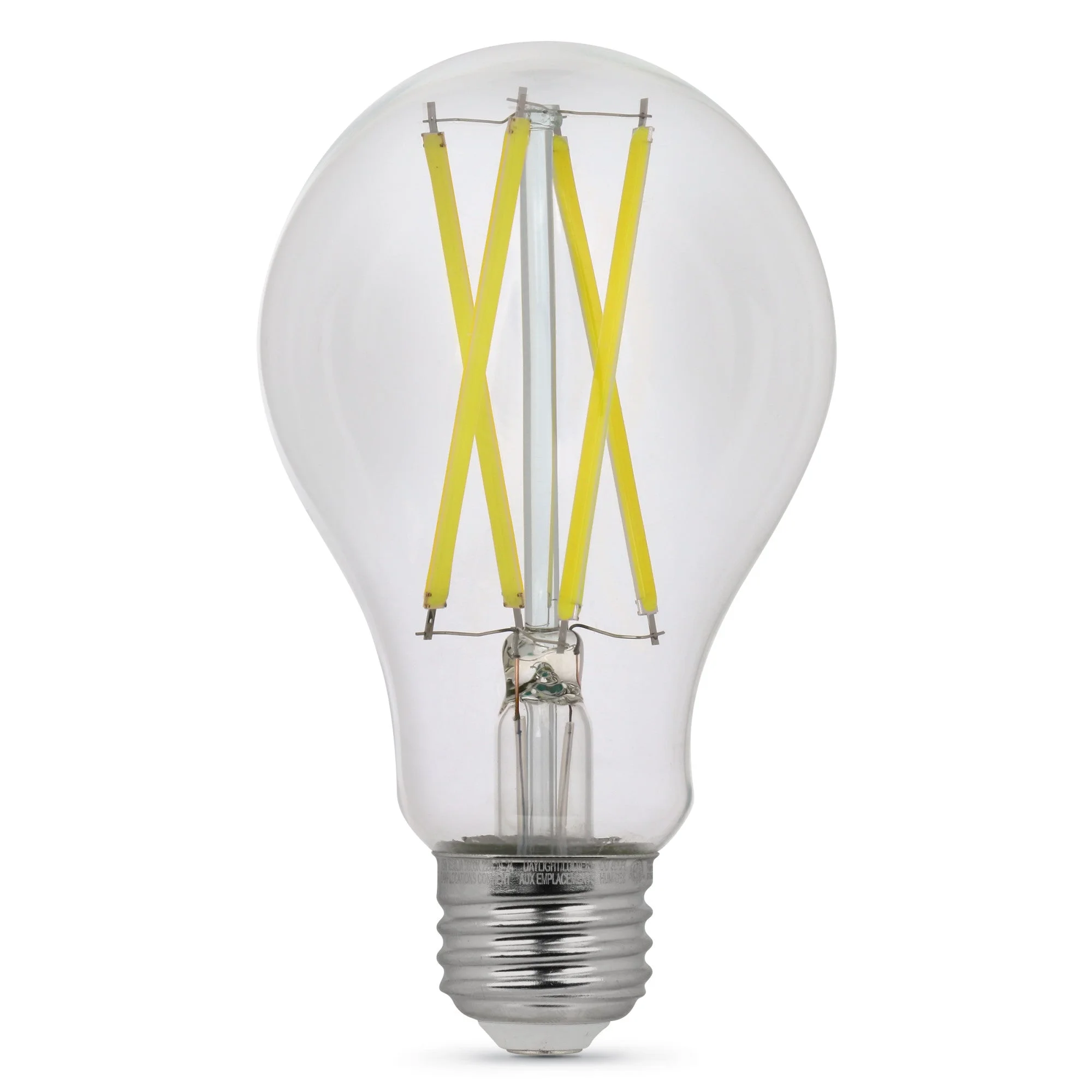
A19 and A21 describe the envelope, not the whole lamp
The letter A identifies the familiar rounded household-bulb envelope. Under the U.S. naming convention, the number represents the nominal maximum diameter in eighths of an inch. An A19 is therefore 19 eighths, or 2.375 inches, across; an A21 is 21 eighths, or 2.625 inches. The difference is one-quarter inch in diameter, so an A21 extends about one-eighth inch farther on each side of its centerline.
That designation does not specify the bulb’s overall length. LED housings, necks, heat-management structures, and internal drivers vary by model. Even products carrying the same A19 or A21 designation can have different maximum overall lengths. Manufacturer dimensions are more useful than the shape code when clearance is tight.
The A code also says nothing by itself about the screw base. Many general-purpose A19 and A21 LEDs sold for U.S. homes use an E26 medium base, including the examples in the supplied manufacturer snapshot, but A19 or A21 and E26 remain separate specifications. Match the base printed on the old bulb, fixture label, or fixture instructions.
Brightness overlaps between the two sizes
Compare brightness in lumens rather than assuming the larger envelope produces more light. The limited manufacturer sample shows substantial overlap. Bulbrite lists an A19 at 1,500 lumens, Philips lists A19 models at 1,500 lumens, and SYLVANIA lists A19 models at 1,600 lumens. Feit lists an A21 at 1,500 lumens as well as a higher-output A21 at 2,605 lumens. Westinghouse lists an A19 at 1,600 lumens.
These examples do not establish universal output ranges, but they demonstrate why shape is an unreliable brightness shortcut. A high-output design may need an A21 envelope, yet manufacturers also produce compact A19 LEDs with output associated with traditional 100-watt incandescent bulbs.
Read the Lighting Facts panel or specification sheet. Lumens describe light output, while watts describe electrical power input. A “100-watt replacement” statement is an output comparison, not the LED’s actual power consumption. Color temperature and color rendering are additional light-quality choices; neither determines whether the bulb physically fits.
- Choose the target lumen output first.
- Treat incandescent-equivalent wattage as a brightness reference only.
- Use the listed LED wattage when checking its actual power input.
- Choose color temperature and color rendering separately from shape and fit.
A shared E26 base does not settle compatibility
Two bulbs can both screw into an E26 socket while differing in voltage, power, controls, and permitted operating conditions. In the supplied U.S. catalog sample, numerous A19 and A21 products are rated for 120 volts, but voltage must still be confirmed on the exact replacement. Do not infer it from the base or envelope code.
Next read the fixture label for its permitted lamp type, maximum wattage, and any shape or size restriction. An LED’s input wattage is distinct from its incandescent-equivalent claim. A 15-watt LED marketed as a 100-watt replacement consumes 15 watts, but staying below a fixture’s wattage ceiling does not override other instructions concerning bulb type, enclosure, orientation, dimensions, or controls.
Three-way sockets, photocells, motion sensors, timers, and smart controls may also impose model-specific requirements. A standard single-level LED may illuminate in a three-way socket without supplying the intended three levels, while a sensor-controlled fixture may require a compatible lamp. Consult the fixture or control documentation rather than treating E26 as a complete compatibility statement.
Clearance can rule out an A21 even when it screws in
The extra quarter-inch of nominal diameter matters around shade rings, narrow glass globes, socket cups, clips, and fixture necks. Overall length can matter at the top of an enclosed globe or beneath a diffuser. The bulb may thread into the socket yet prevent the lens from closing, touch a shade, or be difficult to grasp for later removal.
Measure the old bulb’s maximum width and its length from the bottom electrical contact to the top. Then measure the narrowest opening and usable interior space in the fixture. Check the replacement manufacturer’s width and maximum overall length rather than relying on a generic diagram. DOE guidance notes that LED drivers can make replacement bulbs comparatively bulky near the base, which is another possible interference point.
Do not force a bulb through a retaining ring or reinstall a cover that presses against it. If the manufacturer specifies a mounting orientation or minimum clearance, follow that instruction. Shut off power and let the old bulb cool before measuring or removing it.
Enclosure, dimmer, and location ratings answer different questions
A fully enclosed fixture traps heat. DOE advises checking the lamp packaging or technical specifications for explicit enclosed-fixture suitability because elevated operating temperature can affect some LEDs’ performance and life. Shape does not answer this question: the snapshot includes A19 products approved for totally enclosed fixtures, while a separate Feit A21 product page identifies a high-output model as not enclosed-fixture rated.
“Dimmable” is another independent specification. A dimmable bulb must also work with the particular dimmer and within its permitted load. Compatibility problems can appear as flicker, limited range, delayed start, ghosting, or failure to switch off cleanly. Dimmer manufacturers such as Lutron publish model-specific compatibility results; the word “dimmable” alone is not a guarantee with every control.
Damp- or wet-location suitability addresses moisture exposure, not heat entrapment. A damp rating generally covers condensation or protected locations, while a wet rating is intended for exposure to dripping, splashing, or flowing water under the stated installation conditions. An outdoor fixture and its bulb must have the ratings required by that location. A damp-rated bulb is not automatically wet-rated, and neither rating establishes enclosed-fixture suitability.
A reliable replacement sequence
Start with the fixture, not the A19-versus-A21 label on a store shelf. Photograph the fixture label and the markings on the old lamp before discarding it. If those markings conflict with a general rule or catalog example, the exact fixture documentation controls.
After confirming electrical and environmental requirements, select the desired lumens and light appearance. Finally, verify the precise bulb dimensions against the available space. An A21 is reasonable only when its specifications satisfy every requirement and the fixture provides enough clearance; an A19 is often the easier physical fit, but its smaller envelope does not excuse any other mismatch.
- Confirm the required base code.
- Match the specified voltage.
- Stay within the fixture’s actual wattage and lamp-type limits.
- Verify dimmer or control compatibility.
- Require an enclosed-fixture rating when the application calls for one.
- Match the dry, damp, or wet-location requirement.
- Check width, overall length, neck clearance, and cover clearance.
Before you buy
A quick replacement check
- Read and photograph the fixture label before removing the old bulb.
- Record the old bulb’s base, voltage, actual wattage, lumens, and shape.
- Measure the old bulb and the fixture’s narrowest opening and usable depth.
- Check the replacement’s published width and maximum overall length.
- Verify that any dimmer, timer, sensor, or three-way socket supports the exact lamp.
- Look for explicit enclosed-fixture approval when a globe or lens traps heat.
- Match the lamp and fixture to the required dry, damp, or wet-location rating.
- Give the fixture label and model instructions priority over general advice.
Common follow-ups
Questions people ask next
Can an A21 LED replace an A19 LED?
Sometimes. It must have the correct base and voltage, remain within the fixture’s restrictions, carry the required dimmer, enclosure, and location ratings, and physically clear the shade or cover.
Is an A21 always brighter than an A19?
No. Manufacturer catalogs include A19 and A21 LEDs with overlapping lumen outputs. Compare the listed lumens on the exact bulbs.
Do A19 and A21 bulbs use the same socket?
Many U.S. household models use an E26 medium base, but the envelope code and base code are separate. Verify the base on each bulb and fixture.
Does a lower-watt LED satisfy a fixture’s maximum-wattage label?
The LED’s actual input wattage is the relevant power figure, not its incandescent-equivalent claim. However, the fixture may also restrict lamp type, shape, dimensions, orientation, or operating conditions, so its complete instructions still apply.
Does a damp rating mean the bulb is suitable for an enclosed outdoor fixture?
No. Moisture-location suitability and enclosed-fixture suitability are separate ratings. Confirm both independently, along with the fixture’s own outdoor and location markings.
Checked against
Sources
- Bulbrite — 14W LED A19 5000K Filament Milky Fully Compatible Dimming ↗Accessed 2026-08-13
- Feit Electric — 15W 100W-Replacement Daylight E26 A21 Glass Filament Enhance LED ↗Accessed 2026-08-13
- Signify — Philips A19 LED Lamp Bulletin PLt-2407BN ↗Accessed 2026-08-13
- LEDVANCE — SYLVANIA LED TruWave A19 100W-Replacement Dimmable Daylight Bulb ↗Accessed 2026-08-13
- Westinghouse Lighting — Westinghouse A19 10-Watt 100-Watt-Equivalent Dimmable Filament LED ↗Accessed 2026-08-13
- U.S. Department of Energy — Purchasing Energy-Efficient Light Bulbs ↗Accessed 2026-08-13
- Federal Trade Commission — Shopping for Light Bulbs ↗Accessed 2026-08-13
- National Electrical Manufacturers Association — American National Standard for Electric Lamps—Nomenclature for Envelope Shapes Intended for Use with Electric Lamps ↗Accessed 2026-08-13