Bulb compatibility
E26 vs GU24 A-Shape Bulbs: Why Similar Light Output Does Not Mean the Same Socket
A19 describes the bulb’s envelope, while E26 and GU24 identify two physically different ways of connecting it to a fixture.
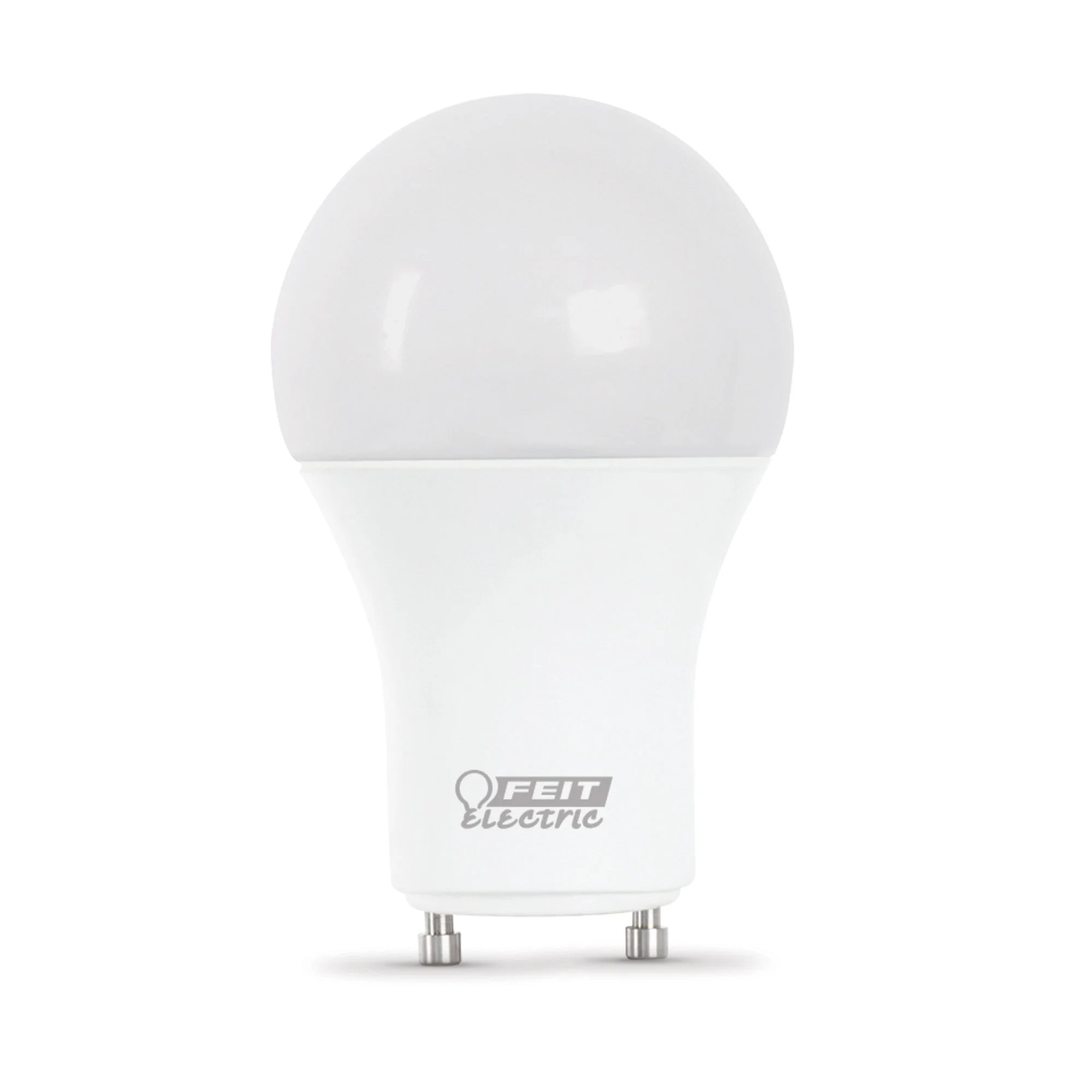
A19 shape and base code answer different questions
An A19 bulb has the familiar general-purpose A-shape envelope. That designation describes the visible body of the lamp, not the connector underneath it. Manufacturers therefore list shape and base as separate specifications: an A19 may have an E26 base, a GU24 base, or another connection when such a model is offered.
E26 is the medium screw base commonly found in U.S. household lamps and fixtures. It has a threaded metal shell and turns into a corresponding socket. GU24 instead uses two pins and a twist-lock connection. The two systems do not mate directly, even when the bulbs above their bases look almost identical.
Base designations are standardized specifications, not descriptions of brightness or bulb silhouette. When identifying a replacement, read the full combination, such as “A19, E26” or “A19, GU24.” Matching only the A19 marking leaves the most important mechanical compatibility question unanswered.
Lumens cannot identify the socket
Lumens describe light output. Watts describe electrical power use. Neither value identifies the base. Two LEDs can produce the same number of lumens while using different connectors, and equal “replacement wattage” language does not change that distinction.
The limited manufacturer sample illustrates the point. Feit lists a 120-volt, 14-watt GU24 A19 producing 1,500 lumens. Philips lists 120-volt, 14-watt E26 A19 models at the same 1,500 lumens. Their output, input power, shape, and nominal voltage can all match while their bases remain incompatible.
The pattern is not restricted to one output level. Bulbrite lists an 800-lumen, 9-watt, 120-volt A19 with an E26 base. Westinghouse lists a 1,600-lumen E26 A19 using 10 watts, while the cited SYLVANIA medium-base A19 produces 1,600 lumens using 15 watts. These are examples from a bounded catalog sample, not a census of available bulbs.
Read each specification independently
A replacement decision becomes much easier when the package and fixture label are treated as a set of separate checks. One matching number cannot stand in for the others.
- Base code determines whether the lamp mechanically connects to the socket.
- Bulb shape describes the envelope and does not guarantee a particular base.
- Voltage states the electrical supply for which the lamp is designed.
- Actual watts state the lamp’s power use and must remain within the fixture’s rating.
- Lumens state total light output and are the useful starting point for matching brightness.
- CCT describes whether the light appears warmer or cooler; it does not affect socket fit.
- Dimmable status applies to the lamp, while successful dimming also depends on the control system’s compatibility list and instructions.
How to identify an unknown socket
Turn the light off before removing the old lamp, and handle it only after it has cooled. Look at the connector rather than relying on the globe. A threaded metal shell points to an Edison screw base; two projecting pins that enter openings and rotate into place point to GU24. Do not confuse GU24 with other pin-base families merely because they also have pins.
Copy the complete code printed on the old lamp if it remains legible. Then inspect the fixture label, socket markings, and model documentation. A package photo is less reliable than a written base specification, especially when an opaque product image hides the connector.
If the old lamp is missing, photograph the empty socket and its markings and measure the available space. Do not force a base that does not engage normally. Unusual resistance can simply mean the base is wrong, misaligned, or not being operated as its fixture instructions require.
Fixture rating, dimming, enclosure use, and location are separate checks
The fixture’s lamp-type and maximum-wattage label remains controlling. The Consumer Product Safety Commission advises using the correct type and wattage stated for the fixture. An LED’s “60-watt equivalent” or “100-watt equivalent” wording refers to an approximate incandescent light-output category; use the LED’s actual wattage when checking electrical load.
Dimming is another independent property. A bulb labeled dimmable still needs a compatible dimmer or control system. A non-dimmable bulb should not be selected merely because another model with the same base and lumen output is dimmable. Manufacturer compatibility documentation is more useful than assuming every LED dimmer combination behaves alike.
An enclosed-fixture rating concerns operation where heat is trapped around the lamp. A damp- or wet-location rating concerns environmental exposure. One does not imply the other. Check both the bulb specification and the fixture documentation for the actual installation.
The cited catalogs show why model-level checking matters. Feit marks its GU24 example as dimmable, damp-location suitable, and enclosed-fixture rated. Bulbrite separately lists dimming, damp-location, and enclosed-use information for its E26 example. Westinghouse likewise states enclosed-fixture approval for its cited E26 model while warning that it may not work with every dimmer.
Physical fit still matters after the base matches
A matching base does not guarantee clearance. LED drivers and housings can make the area near the base wider than an older incandescent lamp, and nominally similar A-shape bulbs can differ in overall dimensions. Compare maximum overall length and diameter with the fixture’s shade, globe, guard, harp, or retaining hardware.
Adapters require the same caution. Even if an adapter creates a mechanical connection between GU24 and E26, it changes the assembled height and may conflict with the fixture’s instructions, enclosure, shade, or listing conditions. Treat the fixture manufacturer’s documentation as the deciding authority rather than assuming an adapter is an ordinary bulb substitution.
Replacing a socket or rewiring a fixture is a fixture modification, not a lamp change. If the correct-base lamp is unavailable or a permanent conversion is being considered, consult the fixture maker’s instructions or a qualified electrical professional instead of improvising inside the fixture.
Before you buy
A quick replacement check
- Confirm the complete base code: E26 and GU24 are not interchangeable.
- Match the lamp’s rated voltage to the fixture supply and documentation.
- Choose lumens for the desired light output, not for socket identification.
- Use actual lamp watts when checking the fixture’s maximum rating.
- Verify both lamp dimmability and dimmer compatibility.
- Check enclosed-fixture and location ratings separately.
- Compare the lamp’s dimensions with the available physical clearance.
Common follow-ups
Questions people ask next
Will an A19 E26 bulb fit an A19 GU24 fixture?
No. A19 identifies the envelope, but E26 and GU24 are different mechanical bases. The replacement must match the socket unless the fixture documentation explicitly permits another arrangement.
Does a 1,500-lumen GU24 bulb equal a 1,500-lumen E26 bulb?
They have similar stated total light output, but that does not make them physically interchangeable. Their distribution, color, power use, controls, ratings, and dimensions may also differ.
Can an adapter convert GU24 to E26?
Adapters exist, but compatibility is not automatic. Check the fixture instructions, resulting clearance, wattage limits, enclosure conditions, and any restrictions before considering one.
Does “100-watt equivalent” mean the LED draws 100 watts?
No. It is a light-output comparison with a traditional incandescent category. Use the LED’s separately stated actual wattage when checking the fixture rating.
Is every dimmable GU24 or E26 LED compatible with every dimmer?
No. Dimmable status is necessary, but the lamp and control must also be compatible. Follow the bulb, dimmer, and fixture manufacturers’ model-specific documentation.
Checked against
Sources
- Bulbrite — 9W LED A19 60W Equivalent Dimmable 3000K E26 120V ↗Accessed 2026-08-13
- Feit Electric — 14W 100W-Replacement Daylight GU24 Base A19 Dimmable LED ↗Accessed 2026-08-13
- Signify — Philips A19 LED Lamps Bulletin ↗Accessed 2026-08-13
- LEDVANCE — SYLVANIA TruWave A19 15W 1,600-Lumen Medium-Base Dimmable LED ↗Accessed 2026-08-13
- Westinghouse Lighting — Westinghouse 5255000 A19 LED Specification Sheet ↗Accessed 2026-08-13
- U.S. Department of Energy — Purchasing Energy-Efficient Light Bulbs ↗Accessed 2026-08-13
- U.S. Consumer Product Safety Commission — Smoke Alarms—Why, Where, and Which, Including Home Electrical Safety Guidance ↗Accessed 2026-08-13
- National Electrical Manufacturers Association — American National Standard for Electrical Lamp Bases—Specifications for Bases ↗Accessed 2026-08-13