Bulb Shapes and Fit
BR30, PAR30, and PAR38 LED Bulbs: How Shape and Beam Angle Change the Light
Shape determines approximate diameter and fit, while beam angle determines how tightly the light is concentrated.
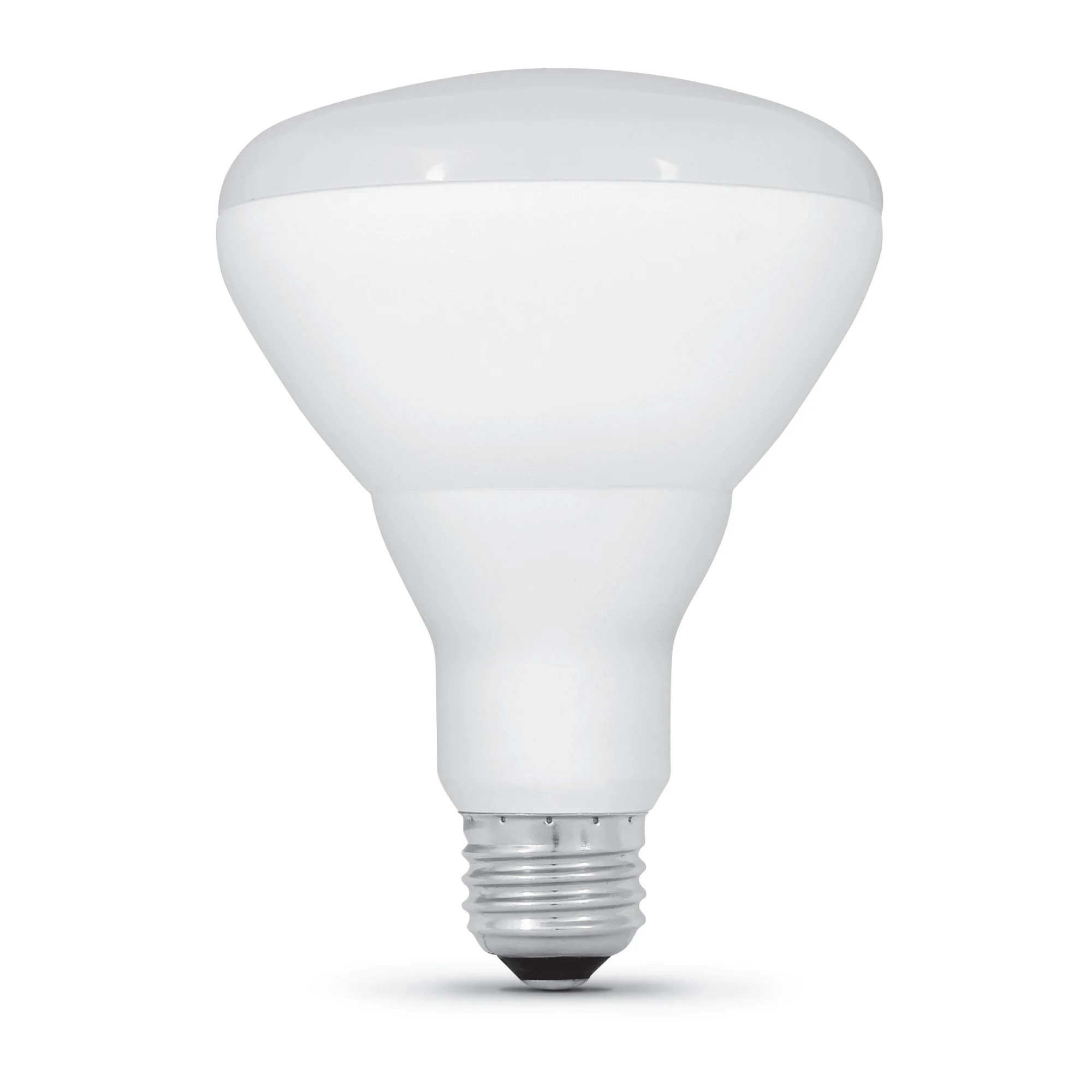
What the BR30, PAR30, and PAR38 names tell you
The letters identify a bulb-shape family, and the number indicates its approximate maximum diameter in eighths of an inch. BR30 and PAR30 bulbs are therefore nominally 30 eighths, or about 3.75 inches, across. A PAR38 is nominally 38 eighths, or about 4.75 inches—roughly one inch wider.
That number does not specify the base, voltage, length, wattage, brightness, or beam angle. Many household examples use a medium E26 screw base and operate at 120 volts, but those are separate specifications that must be checked on the replacement bulb.
BR30 and PAR30 share a nominal diameter but have different outlines and optical designs. PAR30 bulbs also come in short-neck and long-neck versions. Actual maximum diameter and overall length matter because an LED’s housing, neck, or face can contact a trim ring even when its shape code appears correct.
Beam angle determines where the lumens go
Beam angle is the angle between the two directions where luminous intensity has fallen to 50 percent of the maximum. It describes the central portion of the beam, not a hard boundary: useful light continues outside the stated angle.
A smaller angle concentrates light into a smaller footprint at a given distance. That can emphasize artwork, a countertop, a display, or part of a landscape. A larger angle spreads light across more of the ceiling, floor, or wall and generally produces less concentrated center illumination when lumen output is similar.
Distance also changes the result. The farther the target is from the bulb, the larger the illuminated footprint becomes. A beam that looks suitably broad from a low ceiling may appear noticeably tighter when aimed from a high ceiling or across a yard.
- Use narrower beams when the target is small or distant.
- Use wider beams when overlapping coverage and evenness matter.
- Compare degree values instead of relying only on “spot” or “flood.”
How the three shapes tend to change a room
BR30 LEDs are commonly designed with very wide flood distributions. They suit recessed cans used for general room lighting because adjacent beams can overlap across a broad area. Their appearance is usually less focused than that of a typical PAR lamp, although the listed angle remains the reliable specification.
PAR30 LEDs commonly provide a more controlled beam while retaining roughly the same nominal face diameter as a BR30. They are often useful in adjustable recessed or track fixtures where the light needs to be aimed. A long-neck PAR30 can place its face farther forward than a short-neck version, so length must match the fixture and trim.
PAR38 LEDs are wider, but wider does not automatically mean a wider beam or greater brightness. PAR38 products are frequently offered with controlled flood beams for track, security, and outdoor fixtures. The larger shape primarily changes physical fit; the beam angle and lumens still determine the lighting effect.
A limited catalog sample shows why the degree value matters
The supplied manufacturer snapshot is not a market census, but its examples illustrate the distinction clearly. A Feit Electric BR30 model lists a 110-degree beam and 1,400 lumens. A Bulbrite PAR30 long-neck model lists a 40-degree beam and 800 lumens, while a Westinghouse PAR38 model lists a 35-degree beam and 1,350 lumens.
These figures do not establish universal beam angles for the three shapes. They show that shape, beam width, and brightness are independent label fields. The BR30 example is slightly brighter than the PAR38 example despite being nominally narrower in diameter, and its beam is much wider.
The examples also separate indoor and outdoor suitability. The Feit BR30 is damp-location rated, while the cited Bulbrite PAR30 and Westinghouse PAR38 are wet-location rated. Those ratings belong to the individual models; neither the BR nor PAR designation guarantees a location rating.
Keep every compatibility check separate
A bulb can screw into a socket yet still be unsuitable for the fixture. Work through each label item independently, and follow the exact fixture label and model documentation when they are more restrictive.
For brightness, compare lumens rather than replacement wattage. Watts state electrical power consumption, while a phrase such as “90-watt replacement” is a light-output comparison with an older lamp. For a fixture’s maximum-wattage limit, use the LED’s actual input wattage and obey any listed lamp-type restriction.
Enclosed fixtures require another check. A closed globe or sealed housing traps heat, which can affect the performance and life of an LED not rated for that environment. An outdoor rating does not automatically establish enclosed-fixture suitability, and an enclosed rating does not establish wet-location suitability.
- Base code: Match the socket, such as E26.
- Voltage: Match the supply stated on the bulb and fixture.
- Fixture rating: Follow its maximum wattage and permitted lamp types.
- Dimmer: Use a dimmable bulb and a dimmer approved for that model or lamp family.
- Enclosure: Verify that the LED permits fully enclosed operation when applicable.
- Location: Match dry, damp, or wet ratings to the actual installation.
- Clearance: Check diameter, overall length, neck length, trim, and aiming range.
A practical way to choose the replacement
First, photograph the old bulb markings and fixture label before removing the lamp. Record the shape, base, voltage, actual wattage, lumens, color temperature, beam angle, and any dimming, enclosure, or location markings. If beam angle is absent, note whether the old result was too narrow, too broad, or satisfactory.
Next, measure the old bulb’s widest point and overall length, along with the available space inside the trim or shade. This is especially important when moving between BR30 and PAR30, choosing a PAR30 neck length, or considering the wider PAR38 shape. Leave enough room to install and remove the bulb without forcing it against the fixture.
Finally, choose the distribution for the job. For ambient downlighting, favor a beam broad enough to overlap neighboring fixtures without obvious bright circles. For accent, track, or security lighting, choose a controlled beam that reaches the target without spilling excessively onto adjacent walls, windows, or neighboring property. If documentation and a rule of thumb disagree, follow the bulb and fixture manufacturers’ instructions.
Before you buy
A quick replacement check
- Confirm the bulb-shape code shown by the fixture documentation.
- Match the socket base and rated voltage separately.
- Compare lumens for brightness and degrees for beam width.
- Check the LED’s actual wattage against the fixture label.
- Verify both bulb and dimmer compatibility before dimming.
- Look for an enclosed-fixture rating when the lamp lacks ventilation.
- Match the bulb and fixture location ratings to the installation.
- Measure width, length, neck reach, trim clearance, and aiming space.
Common follow-ups
Questions people ask next
Can a PAR30 replace a BR30?
Sometimes. Their nominal diameters are similar, but the PAR30 may have a different length and a tighter beam. The base, voltage, fixture rating, dimmer, enclosure and location ratings, and physical clearance must all match.
Can a PAR38 replace a PAR30?
Not automatically. A PAR38 is nominally about one inch wider, so it may not clear the trim or housing even if both bulbs have E26 bases. It can also have a different beam angle, lumen output, and overall length.
Does an E26 base mean the bulb is compatible?
It confirms the screw-base size only. Shape, voltage, actual wattage, fixture restrictions, dimming, enclosure rating, location rating, and physical clearance remain separate checks.
Is every BR30 wider-beamed than every PAR bulb?
No. Wide BR30 beams and narrower PAR beams are common patterns, not guarantees. Read the listed beam angle for the exact model; terms such as “flood” alone are not precise enough for a close match.
Checked against
Sources
- Bulbrite — 10W LED PAR30 Long Neck 3000K 90 CRI Flood Wet Dimmable ↗Accessed 2026-08-13
- Feit Electric — 14W Soft White E26 BR30 Dimmable LED ↗Accessed 2026-08-13
- Westinghouse Lighting — 15W PAR38 Flood Dimmable LED Bulb with Selectable Color Temperature ↗Accessed 2026-08-13
- LEDVANCE — LED Lamp and Retrofit Catalog ↗Accessed 2026-08-13
- Illuminating Engineering Society — Beam Angle Definition ↗Accessed 2026-08-13
- U.S. Department of Energy — Purchasing Energy-Efficient Light Bulbs ↗Accessed 2026-08-13
- Federal Trade Commission — Shopping for Light Bulbs ↗Accessed 2026-08-13
- U.S. Consumer Product Safety Commission — Home Electrical Safety Checklist ↗Accessed 2026-08-13